


Owning a tropical sanctuary comes with a hidden challenge: the battle against rapid algae growth in the humid climate. Many foreign investors watch their bookings evaporate as reviews mention cloudy water or skin irritation, unaware that their pool care routine is insufficient. In a competitive market, visual clarity is not enough; hygiene must be clinically verified to prevent guest illness and bad press.
The root of the problem often lies in a misunderstanding of local requirements and the unique chemistry needed for this environment. While you might rely on a freelance pool technician, inconsistent dosing and lack of filtration oversight can lead to bacterial spikes that violate health codes. Ignoring these biological realities puts your guests at risk and exposes your business to significant liability.
To secure your revenue and reputation, you must implement rigorous protocols that go beyond simply skimming leaves. Adhering to professional Bali villa pool maintenance standards ensures your water remains pristine and compliant with Indonesian health regulations. Partnering with an established villa management firm can further automate this process, guaranteeing that your property meets the high expectations of international travelers.
Table of Contents
Indonesian Health Regulations: Permenkes 32/2017
Foreign owners often assume that private villa pools are exempt from the strict oversight applied to large hotels, but this is a dangerous misconception. Once you market your property for short-term rentals, you are effectively operating a commercial facility. The regulatory baseline in Indonesia is set by the Ministry of Health Regulation (Permenkes) No. 32 of 2017, and updated by No. 2 of 2023. These regulations dictate the environmental health quality standards required for swimming pools, sanitary facilities, and public baths.
Compliance is not just about avoiding potential fines; it is about shielding your business from liability. These regulations mandate specific thresholds for physical, chemical, and microbiological quality. For instance, the presence of E. coli or total bacteria counts above permitted levels is a direct violation that can result in guest infections. While enforcement inspections on private villas may be sporadic, a guest falling ill due to contaminated water can lead to severe legal and reputational consequences.
Essential Chemistry: pH, Chlorine, and Alkalinity Targets

The tropical heat and intense UV index in Bali accelerate chlorine dissipation, making chemical balance far more volatile than in cooler climates. According to Permenkes and international best practices, the optimal pH range for pool water is between 7.2 and 7.8. If the pH rises above 7.8—common in cement-lined pools—the sanitizing power of chlorine drops drastically, allowing algae to bloom even if your chlorine levels seem adequate.
For disinfection, maintaining a Free Chlorine residual of 1–3 mg/L (ppm) is the gold standard. This range ensures that bacteria are killed instantly while remaining comfortable for swimmers. It is crucial to test these levels daily. Many local operators may rely on guesswork or add chemicals only once a week, which causes a “yo-yo” effect where active sanitization levels drop to zero days before the next service, inviting algae spores to take hold.
Daily and Weekly Physical Maintenance Checklists
Chemistry alone cannot keep a pool pristine; it requires rigorous physical effort. A compliant maintenance schedule should include daily skimming to remove organic debris like frangipani flowers and leaves. As these organics decompose in the water, they consume chlorine and release phosphates, which act as fertilizer for algae.
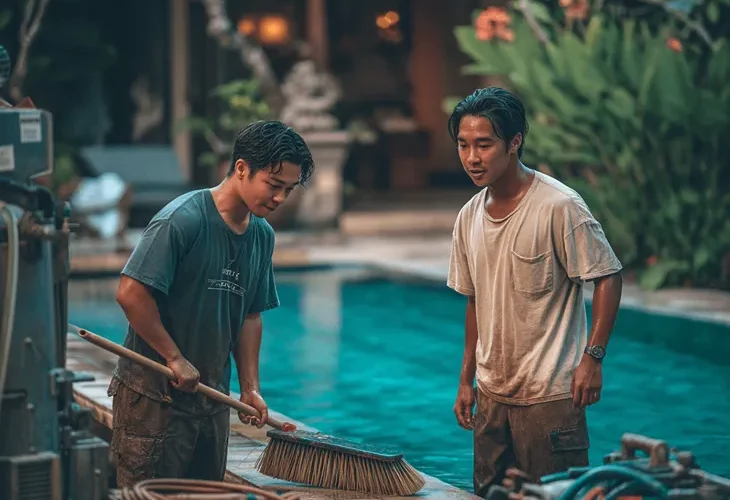
Weekly tasks are equally critical for adhering to strict Bali villa pool maintenance standards. The pool walls and floor must be brushed to disrupt the biofilm—a protective slime layer that bacteria and algae form to shield themselves from chlorine. Vacuuming should be performed thoroughly to remove sediment. Furthermore, the skimmer baskets and pump baskets must be emptied regularly to ensure the circulation system is not choked, as poor flow leads to stagnant zones where algae thrive.
Filtration and Circulation: The Hidden Algae Causes
Even with perfect chemical dosing, a pool will turn green if the water is not moving. The filtration system is the heart of your pool’s hygiene. In Bali, where dust and pollen are prevalent, sand filters can become clogged quickly. Failing to “backwash” (clean) the filter weekly reduces its ability to trap contaminants, leaving water cloudy and safe harbor for microbial growth.
Circulation time is another common failure point. To save on electricity, some owners reduce the pump running time to only a few hours a day. However, in a tropical climate, water needs to be turned over (passed through the filter) at least twice a day. This typically requires running the pump for 8 to 12 hours. Stagnant water under the hot Balinese sun is essentially a petri dish; ensuring constant movement is the most energy-efficient way to prevent an expensive algae bloom.
Real Story: Saving a Green Pool in Uluwatu Bali
Elias, a Munich-based entrepreneur, had just opened his dream cliffside villa in Uluwatu. Everything was perfect—until the first January monsoon.
Within 48 hours, his crystal-clear infinity pool transformed into what looked like a bowl of thick Matcha tea. With a high-profile family from Singapore checking in the next day, Elias was panicking. His local gardener kept adding more chlorine, but the water stayed stubbornly murky. The villa began to smell like a public swimming pool—that pungent “bleach” scent that actually signals the chlorine has given up the fight.
Elias realized his gardener was relying on “eye-balling” the chemicals. He took over, stayed up half the night shocking the water, and scrubbing the limestone-clogged filters.
He didn’t just fix the water; he fixed his system. He installed a digital monitoring station and a mandatory daily logbook. He saved the booking and earned a 5-star review, but he learned the hard way: In Bali, “clear water” isn’t a gift from nature—it’s a clinical result of daily discipline.
Emergency Algae Protocol: Shocking and Recovery

When prevention fails and algae appears, speed is essential. The first step is “shocking” or super-chlorinating the water. This involves raising the chlorine level to 10–20 ppm temporarily to burn off organic contaminants and kill resistant algae strains. This should only be done at night to prevent the sun from burning off the chlorine before it works.
Simultaneously, you must brush the entire pool vigorously to detach algae from the porous stone or tiles. Once the algae is suspended in the water, run the filter continuously until the water clears, backwashing frequently to remove the dead algae. In severe cases, a flocculant may be needed to clump particles together so they sink to the bottom for vacuuming. Never allow guests to swim during this treatment until chlorine levels drop back below 4 ppm.
The Danger of Raw Water Top-Ups
Water scarcity is a serious issue in Bali, and buying trucked water is a common necessity during the dry season. However, not all water sources are equal. Some independent water truck vendors source their water from rivers or untreated wells, which can be laden with nitrates, phosphates, and even agricultural runoff.
Filling your pool with this “raw” water is like dumping fertilizer into it. It introduces a massive biological load that consumes your chlorine instantly. Always verify the source of your water deliveries. While treated water from PDAM (the government water utility) is safer, if you must use trucked water, test it immediately upon delivery and be prepared to shock the pool to neutralize any introduced contaminants before they destabilize your water balance.
Common Mistakes: Why "Clear" Isn't Always Safe
The most dangerous misconception among villa owners is that clear water equals clean water. A pool can look sparkling clear but still have a low pH that is acidic enough to irritate skin, or contain high levels of bacteria because the chlorine has been exhausted. This “false positive” leads to complacency.
Another frequent error is the lack of proper testing equipment. Relying on cheap, sun-faded test strips often results in inaccurate readings. Every villa should invest in a high-quality liquid test kit (DPD style) or a digital meter. Furthermore, failing to adjust Alkalinity (TA) leads to pH bounce, where pH levels swing wildly despite your best efforts. Neglecting these invisible chemical factors is a primary reason why many properties fail to maintain consistent Bali villa pool maintenance standards over the long term.
FAQ's about Bali Villa Pool Maintenance
In Bali's tropical climate, professional servicing (cleaning, vacuuming, and chemical balancing) is recommended at least 2–3 times per week, with daily skimming and visual checks.
The ideal pH range is between 7.2 and 7.6; this range prevents eye irritation, protects pool equipment from corrosion, and ensures chlorine remains effective against algae.
Rainwater dilutes your pool's chemicals and often washes in nitrogen and phosphates from the air and surrounding garden, which act as fertilizer for algae bloom.
Saltwater systems still produce chlorine to sanitize the water but are generally gentler on the skin; however, the salt cell requires strict maintenance to prevent calcification in Bali's hard water.
It is highly discouraged to use untreated river or well water as it often contains pollutants, fertilizers, and algae spores that can ruin your water chemistry and endanger health.
Villa pools effectively fall under Permenkes No. 32 of 2017, which sets hygiene and safety standards for public and commercial swimming pools, requiring strict control of bacteria and chemical levels.