



Managing a property in Bali or Jakarta is no longer as simple as uploading a few photos and waiting for guests to arrive. The market has matured significantly, and with the Indonesian government tightening regulations on short-term rentals, competition is fierce. Foreign investors often find themselves puzzled when a beautiful villa in a prime location like Canggu or Uluwatu sits empty while neighboring properties are fully booked. To succeed in this landscape, you must treat your property as a professional business entity, not a passive side hustle.
The key to visibility lies in understanding what the platform’s algorithm currently rewards: specifically, trust, legality, and responsiveness. In 2026, the algorithm heavily favors listings that demonstrate reliable hosting history and full legal compliance. Ignoring these factors can lead to sudden delisting or invisibility in search results. By systematically optimizing your operations, from securing your business license via the Online Single Submission (OSS) system to refining your pricing strategy, you can secure a sustainable competitive advantage.
This guide outlines a proven roadmap to elevate your performance. We move beyond basic advice to provide actionable, location-specific strategies for the Indonesian market. Whether you are a veteran host or a new investor, applying these steps will help you maximize occupancy and revenue. Here is how to professionally optimize your Airbnb listing in Indonesia for maximum visibility.
Table of Contents
Step 1: Secure Your Legal Foundation
The most critical step to boosting your Airbnb listing in Indonesia happens offline. In the past, many hosts operated in a “grey area,” but recent regulatory shifts in Bali and Jakarta have made legal compliance mandatory for long-term survival. Airbnb is increasingly integrating with local tax and tourism databases. If your property lacks the correct zoning (ITR), building permit (PBG/SLF), or tourism license (TDUP/NIB), you risk being flagged by both the government and the platform.
A compliant listing is a stable listing. When you verify your business registration with the platform, you signal to the algorithm that you are a legitimate operator. This prevents the disastrous ranking drops that occur when a listing is reported or investigated. Before worrying about keywords or decor, ensure your property holds a valid Sertifikat Standar for accommodation. This legal safety net allows you to operate confidently, knowing your revenue stream won’t be severed by a sudden enforcement sweep.
Step 2: Upgrade Visual Storytelling
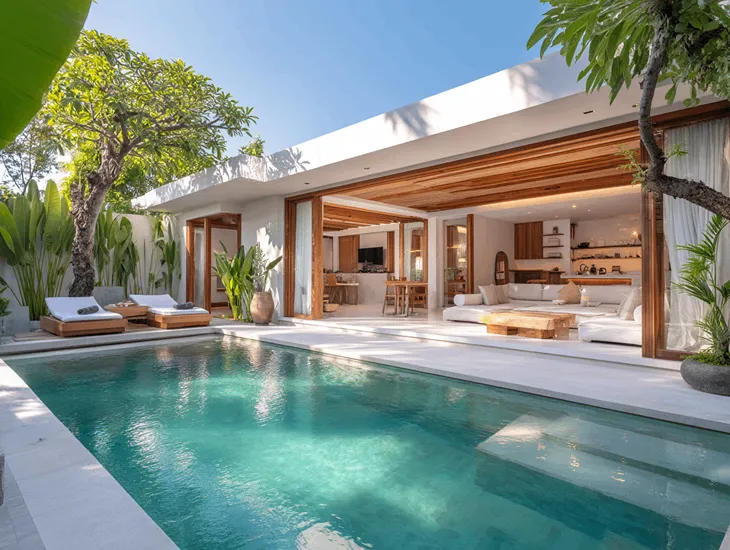
Your cover photo is the single most important factor driving your Click-Through Rate (CTR). In a visual-heavy market like Indonesia, guests scroll rapidly through hundreds of options. If your hero image is dim, cluttered, or generic, you lose the booking before the guest even reads your title. Data suggests that professional photography can increase booking conversion by up to 40%. You need bright, high-resolution images that capture the unique “feeling” of the space—whether that is the morning light hitting a private pool in Ubud or a sunset view from a Seminyak loft.
Beyond the cover shot, your gallery must tell a cohesive story. Include at least 15 to 20 photos that detail not just the bedrooms, but the amenities that matter to modern travelers. Show the workspace setup, the internet speed test result, and the quality of the bathroom fixtures. In Indonesia, where humidity and maintenance can be issues, crisp and recent photos reassure guests that the property is well-maintained to [upgrade your property visuals]. Refresh your gallery seasonally to show that the listing is active and cared for.
Step 3: Master Airbnb SEO Titles
Airbnb functions like a vertical search engine, and your title is your primary keyword hook. Avoid abstract names like “Serenity Villa 1”; instead, use a formula that highlights value and location. A strong title might read: “Luxury Pool Villa in Canggu – Fast WiFi & Ricefield View.” This approach immediately tells the potential guest—and the algorithm—exactly what you are offering. Including specific amenities like “AC,” “Work Desk,” or “Near Beach” in the title can significantly improve your visibility for users filtering for those specific needs.
Furthermore, you must complete every single field in the backend of your Airbnb listing in Indonesia. The algorithm favors “complete” listings because they provide a better user experience. This includes detailed captions for photos, a fully filled-out “House Rules” section, and a comprehensive amenities checklist. Do not leave the “Neighborhood” description blank; use it to mention proximity to popular cafes or beach clubs, as these are keywords guests often type into the search bar.
Step 4: Cultivate Five-Star Reviews
Hospitality is the heart of the ranking system. A listing with a 4.9-star rating will almost always outrank a 4.5-star competitor, regardless of price. In Indonesia, guests often complain about discrepancies between photos and reality—such as construction noise or dampness. To combat this, honesty is your best policy.
If there is construction next door, mention it and offer a discount. This transparency manages expectations and protects your review score from plummeting due to “inaccurate description” complaints.
Speed is also a ranking factor. To maintain a competitive Airbnb listing in Indonesia, you should aim to respond to every inquiry within an hour. The algorithm tracks your response rate and time, prioritizing hosts who are active and engaged. Additionally, adopting a “zero-cancellation” policy is non-negotiable.
Canceling a confirmed booking is the fastest way to tank your ranking. If you must manage availability, block the calendar dates in advance rather than canceling on a guest. Reliability builds the trust score that pushes your listing to the first page.
Step 5: Implement Dynamic Pricing
Static pricing is a revenue killer in a market as volatile as Bali. Demand fluctuates wildly between the high season (July-August, December) and the low season (February-March). If your price is set and forgotten, you are either leaving money on the table during peak times or sitting empty during quiet months. To optimize your Airbnb listing in Indonesia, you need to use dynamic pricing tools that adjust your nightly rate based on local demand, competitor occupancy, and seasonality.
Updating your calendar and pricing daily also signals to the algorithm that the host is active. Even small adjustments of a few dollars can trigger a “freshness” signal. During low demand periods, consider offering aggressive discounts for weekly or monthly stays. Long-term guests, such as digital nomads, are a massive demographic in Indonesia. By specifically targeting this group with competitive monthly rates, you can maintain high occupancy even when short-term tourism dips.
Why Compliance is Now a Growth Strategy

Many foreign owners view compliance as a hurdle, but in 2026, it is a marketing asset. Guests are becoming more savvy; they read horror stories of tourists being evicted from illegal villas by local authorities. By explicitly stating in your description that your property is a licensed rental with all tax obligations met, you provide peace of mind. This trust factor can be the tie-breaker for a guest choosing between your legitimate villa and a questionable, cheaper alternative.
Furthermore, compliant villas face fewer disruptions. You avoid the risk of neighborhood Banjar disputes or sealing by the Satpol PP (Public Order Agency). Stability allows you to build a long-term review history without having to delete and re-list your property to hide from enforcement. In the long run, the cost of compliance is far lower than the cost of losing your business entirely. You should [consult a revenue expert] to align your pricing with your compliance costs.
The Impact of Seasonality on Rankings
Understanding the rhythm of Indonesian tourism is vital for maintaining the rank of your Airbnb listing in Indonesia. The algorithm rewards consistency. If you go dark (zero bookings) for three months during the wet season, it takes significant effort to climb back up the rankings when the sun comes out. The strategy here is to pivot your offering based on the calendar.
During the rainy season, update your photos to show the cozy interior aspects of your villa—Netflix setups, covered patios, and comfortable bedding. Shift your keywords to target “Retreat,” “Workation,” and “Relaxation.” During the dry season, pivot back to “Sun,” “Pool,” and “Surf.” By aligning your content with the seasonal intent of travelers, you keep your conversion rates high year-round, which keeps the algorithm happy.
Real Story: From Delisted to Fully Booked
Julian, a graphic designer from Berlin, assumed that finishing his three-bedroom villa in Pererenan was the hard part. He was wrong. After three months of zero bookings and mounting maintenance costs, he realized that a beautiful villa is a liability if the algorithm doesn’t know it exists. Worse, he was operating without clear legal standing, leaving his entire investment vulnerable to local enforcement.
The turning point came when Julian realized he was invisible online. He partnered with a professional management team to audit his setup. First, they regularized his PBG and tax registration, removing the legal anxiety. Next, they replaced his amateur photos with professional, bright architectural shots that highlighted the villa’s enclosed living area—a huge selling point in humid Pererenan. Finally, they implemented dynamic pricing.
Within three weeks of the relaunch, Julian secured his first month-long booking from a digital nomad couple. By using a strategy focused on legal compliance and algorithmic optimization, his occupancy jumped to 90% within four months. Julian went from stressing over electricity bills to planning his second investment, proving that in Bali, professionalizing your approach is the only way to scale.
FAQs about Airbnb Hosting
Strictly speaking, running a rental business requires a business license. While some individuals use local nominees, this is high-risk. The safest route for foreigners to operate a compliant Airbnb listing in Indonesia is through a PT PMA (Foreign Owned Company) or a management company that holds the correct licenses.
When you first publish, Airbnb gives you a temporary boost in search results to help you get your first three reviews. It is crucial to have perfect pricing and photos during this window. If you squander this period with high prices or bad photos, it is very hard to gain momentum later.
Common reasons include a lack of recent calendar updates, too many host cancellations, or overly restrictive settings (like 7-night minimums). Ensure your calendar is open and your "Instant Book" feature is turned on to improve visibility for your Airbnb listing in Indonesia.
While not mandatory, Superhost status grants a badge that builds instant trust. More importantly, the algorithm filters often used by guests prioritize Superhosts. Achieving this requires a 4.8+ rating, a <1% cancellation rate, and a 90% response rate.
Extremely important. Bali attracts a massive number of remote workers. Listings that display a verified speed test (a feature within Airbnb) get booked faster. If your Wi-Fi is slow, you will lose the lucrative long-stay demographic.