


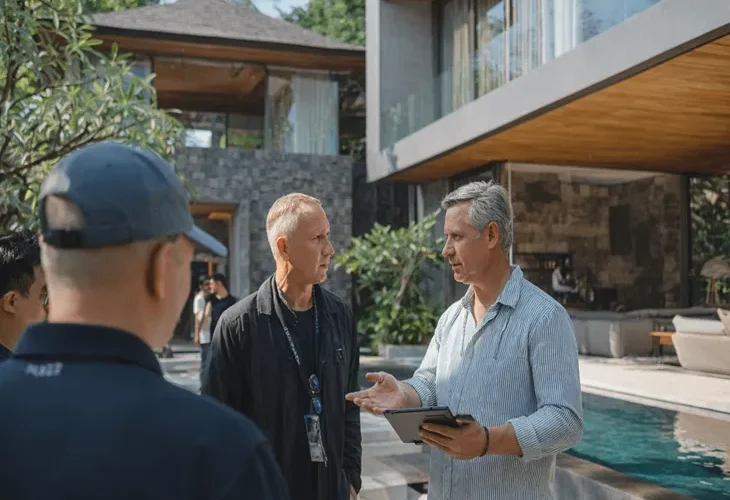
Investing in Bali’s property market in 2026 offers immense potential, but many newcomers are seduced by “Instagram-ready” designs that prove disastrous in reality.
Aesthetic-first choices, like sealed glass boxes, often fail to account for the island’s intense humidity, leading to astronomical cooling costs and rapid structural degradation.
Without a design strategy that respects the local environment, your dream project can quickly become a financial liability.
The consequences of ignoring climate realities are compounded by a stricter regulatory environment.
Provincial authorities are cracking down on buildings that do not meet spatial planning (KKPR) or building worthiness (SLF) standards. Investors who bypass these essential compliance steps risk facing government sanctions, including sealing or demolition.
Success requires more than just a beautiful facade; it demands a deep understanding of how design intersects with Indonesian law.
The solution is to embrace a holistic approach to contemporary architecture villa in Bali. By blending modern minimalist aesthetics with traditional passive cooling techniques and strict legal adherence, you create a high-performing asset.
This strategy not only ensures operational efficiency and legal safety but also positions your property as a premium product in the competitive, highly regulated tourism market.
Table of Contents
Defining the Modern Tropical Aesthetic in Bali
The evolution of contemporary architecture villa in Bali in 2026 is defined by a sophisticated restraint. Gone are the days of heavy traditional ornamentation; today’s premier villas showcase clean rectangular volumes, flat or low-slope roofs, and a seamless transition between indoor and outdoor spaces.
The aesthetic prioritizes open-plan living where the kitchen and lounge flow directly onto the pool deck, utilizing floor-to-ceiling glass and skylights to flood the interior with natural light.
Prominent examples, such as the sleek residences in Cemagi or the dark-tiled pool villas gaining popularity, illustrate this shift.
These designs maintain a deep tropical feel not through carvings, but through the integration of nature—shaded terraces, internal water features, and expansive garden views.
By adopting this minimalist form, investors can maximize land usage in high-value zones while delivering the serene, uncluttered experience that modern travelers demand.
Climate-Smart Design: Passive Cooling and Airflow
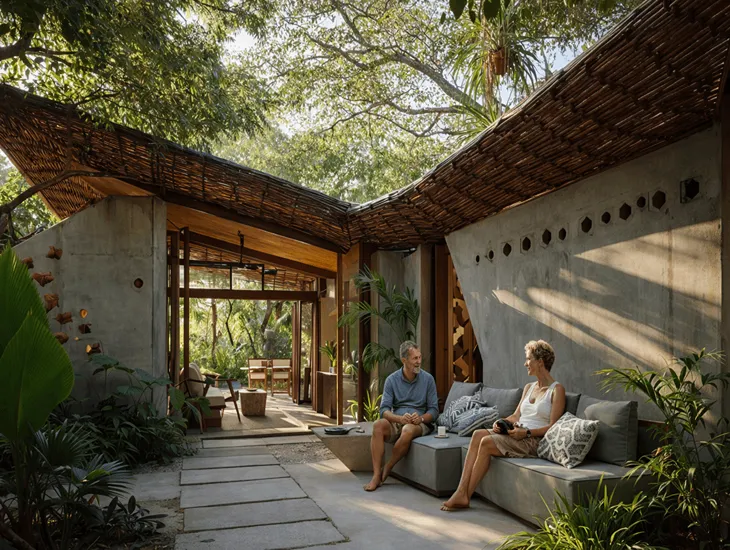
In Bali’s equatorial climate, true luxury is thermal comfort without the constant hum of air conditioning.
Leading examples of contemporary architecture villa in Bali achieve this through rigorous passive design strategies.
Academic sources and sustainability experts emphasize that the Balinese climate demands cross-ventilation, wide roof overhangs, and permeable walls rather than sealed envelopes. These features block direct solar gain while allowing breezes to flush out hot air.
Case studies like Villa RR and Soori Bali demonstrate the power of these principles. By orienting openings toward prevailing winds and utilizing central courtyards, these properties reduce daytime cooling loads by significant margins. Sustainable practices now routinely include natural ventilation paths, high-grade insulation, and solar integration.
This approach ensures that your villa remains a sanctuary of “tropical tranquility”—cool, quiet, and efficient—rather than a greenhouse fighting the sun.
The Regulatory Blueprint: KKPR, PBG, and SLF
In the 2026 landscape, contemporary architecture villa in Bali cannot be separated from compliance. The design process must begin with the KKPR (spatial planning approval), which confirms that your land is legally zoned for residential or tourism use.
Without this foundational approval, even the most stunning architectural concept is rendered useless, as construction permits will be systematically blocked by the government’s online systems.
Following zoning, the PBG (Persetujuan Bangunan Gedung) serves as the technical green light. This approval assesses your architectural drawings, structural integrity, and MEP systems against national safety codes.
Once construction is complete, the SLF (Sertifikat Laik Fungsi) certifies that the building is safe and habitable.
For investors planning to generate rental income, holding a valid SLF is increasingly mandatory for securing business licenses and listing on major OTA platforms without risk of audit.
From Sketch to Site: The Legal Permitting Flow
Navigating the path from concept to completion requires a structured workflow. It starts with a definitive land check to verify rights—whether Leasehold, HGB, or Hak Pakai—and confirming spatial conformity via the OSS RBA system.
Once the land is secured, you must work with architects experienced in contemporary architecture villa in Bali to develop a concept that respects local setbacks, height limits, and environmental constraints.
The technical documentation phase involves preparing detailed structural analysis, site topography plans, and environmental assessments. These are submitted for PBG application, where authorities review compliance.
While review times vary, a typical window is often 30–60 working days. Construction must strictly follow the approved PBG; deviating to add extra floors or change massing can trigger severe delays. Finally, submitting as-built drawings for SLF issuance ensures your villa is legally recognized and ready for operational setup.
Avoiding the "Instagram Trap": Common Design Mistakes
A frequent pitfall in contemporary architecture villa in Bali is prioritizing visual impact over livability.
Many investors commission “glass box” designs that look incredible on social media but function poorly in the tropics. Without adequate shading or drainage planning, these structures suffer from the “greenhouse effect,” leading to unbearable internal temperatures, mold growth from trapped humidity, and chronic roof leaks during the monsoon season.
Another major error is commencing construction before the PBG process is finalized. Assuming that permits can be “fixed” later is a dangerous gamble in 2026, often leading to inflated rectification costs or stalled projects.
Furthermore, the overuse of imported materials can increase maintenance headaches. Sustainability data suggests that utilizing local materials and passive cooling techniques not only reduces energy usage by up to 90% but also lowers the long-term cost of ownership compared to imported, energy-intensive alternatives.
Real Story: Marcus’s Architecture Audit in Cemagi, Bali
For Marcus, the vision was clear: a sleek, glass-enclosed cube sitting starkly against the lush Cemagi coastline.
It was meant to be a masterpiece of modern restraint, mirroring the industrial aesthetics he admired in Berlin.
But within weeks of completion, the villa’s atmosphere shifted from serene to stifling. The midday sun baked the glass facades, and the roar of monsoon rain on the flat metal roof made conversation impossible. The house was beautiful to look at, but impossible to live in.
Six months after moving in, the dream turned into an uncomfortable reality. The interior temperature hovered around 34°C by noon, forcing his industrial AC units to run non-stop.
Recognizing that the design was a financial liability, Marcus engaged Bali Villa Management to conduct a structural audit.
We helped him retrofit timber louvers for shading and redesigned the drainage system to handle the tropical downpours.
The intervention transformed his asset from an unlivable hotbox into a cool, compliant example of contemporary architecture villa in Bali that finally earned the reviews he expected.
Material Selection: Blending Luxury with Locality

Materiality is the language of contemporary architecture villa in Bali. The most successful projects utilize a palette that bridges modern luxury with local availability.
Premium finishes like volcanic rock, sustainable bamboo, and reclaimed ironwood are combined with large glass expanses to create textures that feel grounded in the island’s geology.
This approach avoids the sterile feel of concrete bunkers while maintaining clean, modern lines.
Using local materials also offers practical benefits. Indigenous stone and timber are acclimated to the humidity and age gracefully, whereas many imported synthetics deteriorate rapidly in the salt air.
Bamboo, when treated correctly, provides a low-carbon structural alternative that appeals to the eco-conscious market. By sourcing locally, investors reduce their carbon footprint and insulate their projects from global supply chain disruptions, ensuring that the villa remains both beautiful and maintainable for decades.
Investment Upside: Marketing Your Architectural Edge
In a saturated market, your architecture is your brand. A villa that can legitimately claim to be “climate-responsive” or “eco-luxury” commands a premium.
Travelers in 2026 are actively seeking wellness-oriented stays that offer connection to nature, and contemporary architecture villa in Bali delivers this through open living spaces and garden integration.
Features like natural airflow and acoustic privacy become unique selling points that differentiate your listing from generic stock.
Beyond marketing, the operational upside is significant. Passive cooling and solar integration directly reduce overheads, improving net ROI.
Furthermore, operating a villa that matches its PBG and SLF designations safeguards your revenue stream against regulatory audits. Platforms and discerning guests are increasingly prioritizing legality and sustainability, meaning that a compliant, well-designed villa is not just a lifestyle choice—it is a superior financial instrument.
FAQs about Tropical Tranquility: Contemporary Architecture for Villas in Bali
It is characterized by minimalist forms, flat or low-slope roofs, open-plan layouts, and a strong indoor-outdoor connection using materials like glass, stone, and wood to create contemporary architecture villa in Bali.
Passive cooling uses natural airflow and shading to lower indoor temperatures, significantly reducing electricity costs and creating a more comfortable, "tropical" living environment than sealed air-conditioned rooms.
Yes, the SLF (Certificate of Functional Worthiness) is increasingly required to prove the building is safe and compliant, which is essential for obtaining tourism licenses and operating legally on OTAs.
No, you must verify the KKPR zoning first. If the land is in a Green Zone (agricultural), you cannot legally build a residential or tourism villa, regardless of the architectural style.
A major mistake is designing "glass boxes" without adequate shading or overhangs, which leads to overheating (the greenhouse effect) and high energy bills in the tropical climate.
Using local materials like volcanic stone or bamboo reduces construction and maintenance costs, appeals to eco-conscious guests, and ensures the building weathers well in the local climate, supporting long-term value.