

As we approach, understanding Subak system preservation, green zone construction laws, and sustainable architecture compliance is vital for any foreigner in Indonesia.
Many investors dream of developing a property overlooking the iconic rice terraces in Bali, but few understand the complex legal landscape protecting these heritage sites.
The allure of waking up to UNESCO-inscribed emerald paddies often blinds buyers to the strict regulations governing agricultural land, leading to costly mistakes and stalled projects.
Building on the protected agricultural belt can result in devastating financial losses, including demolition orders and the inability to secure rental licenses.
Without proper due diligence regarding the Subak system and spatial planning, your dream project could become a legal nightmare.
In a time where satellite surveillance is common, reliance on “connections” or verbal assurances is no longer a viable strategy for property investment in Bali.
This guide navigates the essential zoning laws, permit requirements, and cultural responsibilities for living near these landscapes.
We ensure your property investment respects the environment while securing the necessary licenses from authorities like the UNESCO World Heritage Centre regarding cultural landscape protection.
Table of Contents
Understanding the Cultural Value of the Subak System in Bali
The ancient irrigation collective of Bali goes far beyond aesthetics; it is rooted in the subak, a cooperative water-management network maintained by local farming communities and water temples.
This system is so integral to the island’s identity that it is globally recognized as a Cultural Landscape.
This designation covers approximately 19,500 hectares of rice terraces in Bali, forests, and temples, forming the backbone of the island’s ecology.
For foreign investors, this means that land is not just “empty space” waiting for development. It is part of a living cultural heritage protected by provincial and national spatial-planning laws.
These regulations enforce special conservation rules to maintain the integrity of the agricultural ecosystem. Disrupting a subak channel or building inappropriately near a water temple is not just a legal violation; it is a breach of customary law (awig-awig) that can lead to severe community sanctions and social ostracization.
Navigating Zoning Laws for Rice Field Developments
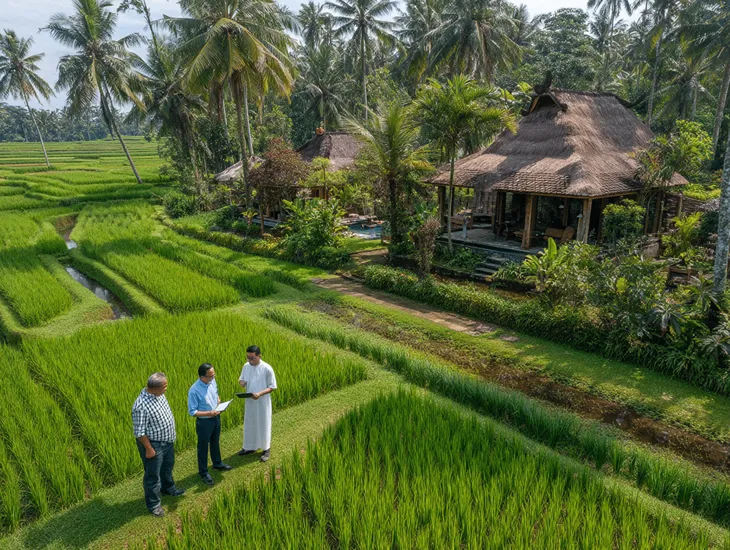
Zoning in 2026 is defined by strict spatial planning laws, agricultural protection, and tourism restrictions, particularly in areas like Ubud and Canggu.
The most critical factor when planning a villa near rice terraces in Bali is the land zoning (ITR – Informasi Tata Ruang). Generally, rice fields fall within the “Green Zone” or Jalur Hijau zones. In these areas, the construction of permanent residential buildings, villas, or hotels is strictly prohibited to preserve food security and environmental balance.
Conversely, “Yellow Zones” (Residential) or “Pink Zones” (Tourism) allow for hospitality projects, provided they are supported by the correct permits.
Crucially, legitimate opportunities exist to build adjacent to green zones. This allows developers to secure a plot in a buildable Yellow Zone that overlooks a protected Green Zone, guaranteeing a permanent view of the rice terraces in Bali without violating the law.
Recent policies have tightened significantly. The government is cracking down on “loophole” permits that previously allowed construction on productive rice land.
Investors must verify that their land is explicitly zoned for tourism or residential use, regardless of what a seller might claim about “future changes” to the zoning map.
Ownership Eligibility and Legal Requirements
To legally develop a property near these scenic areas, foreigners must adhere to national property laws. You cannot hold a Freehold (Hak Milik) title; instead, you must operate through a Leasehold agreement or establish a PT PMA (Foreign Owned Company) to secure a Right to Build (Hak Guna Bangunan) or Right to Use (Hak Pakai) title.
These titles provide a secure legal footing for foreigners to build and operate businesses.
Before purchasing any land, you must obtain a Zoning Confirmation or Spatial-Use Letter (KKPR/PKKPR) from the local authorities.
This document confirms that the specific plot is eligible for your intended use. It also checks for any overlapping status, such as being part of a strategic cultural area or a conservation zone, which would impose further restrictions on building height and density.
Where land is part of a local “strategic area,” additional buffers apply. For example, you may be required to maintain a specific setback distance from irrigation canals to ensure the flow of water to downstream farmers is never impeded. Ignoring these buffers can lead to immediate permit revocation.
Step-by-Step Guide to Building Legally
Developing a villa that capitalizes on the view of rice terraces in Bali while remaining compliant involves a rigorous process. It typically begins with a comprehensive land due diligence check to verify the zoning status (Yellow/Tourism vs. Green/Conservation) and ensure no subak protections are violated.
This initial step is the most critical safeguard against future legal issues.
Once the land status is clear, the next step is establishing your legal entity, such as a PT PMA, and registering the land rights.
Architectural plans must be drawn to respect building-height limits—usually capped at 15 meters or the height of a coconut tree—and adhere to the Building Coverage Ratio (KDB), which dictates how much of the land can be covered by concrete versus green space.
The permitting phase involves applying for the Building Approval (Persetujuan Bangunan Gedung or PBG) and, upon completion, the Certificate of Functional Worthiness (SLF).
For larger projects, environmental assessments like UKL-UPL or AMDAL are mandatory to prove that the development will not degrade the surrounding rice terraces in Bali.
Finally, if the villa is for commercial use, a tourism business license (PB UMKU/TDUP) is required to operate legally.
Real Story: The "Green Zone" Trap in Seseh, Bali
For Elias, a German architect, the plot in Seseh was a dream manifest: emerald paddies stretching toward the ocean’s horizon.
It was the kind of silence he had moved from Germany to find. But as he stood on the land, watching the smoke rise from burning rice stalks, the reality of the living landscape hit him. This wasn’t just scenery; it was active farmland.
That gut instinct led him to pause the deposit and ask the hard questions about what lay beneath the lush surface.
The landowner had assured him that although the land was zoned Green, a “connection” at the local office could secure a permit.
However, Elias decided to consult with a professional legal team just to be safe. The investigation revealed that the plot was not only in a strict agricultural zone but also part of a protected subak irrigation channel buffer.
Building there would have been illegal, and the promised “permit” was a fake document that would never pass the SLF stage.
Changing his approach, Elias worked with the consultants to find a plot just 600 meters east. This land was zoned Yellow (Residential) but bordered the exact same stretch of rice terraces in Bali.
He secured the land legally, built his villa with full PBG and SLF compliance, and now enjoys the same breathtaking view without the looming threat of demolition.
Risks and Common Mistakes for Foreign Investors
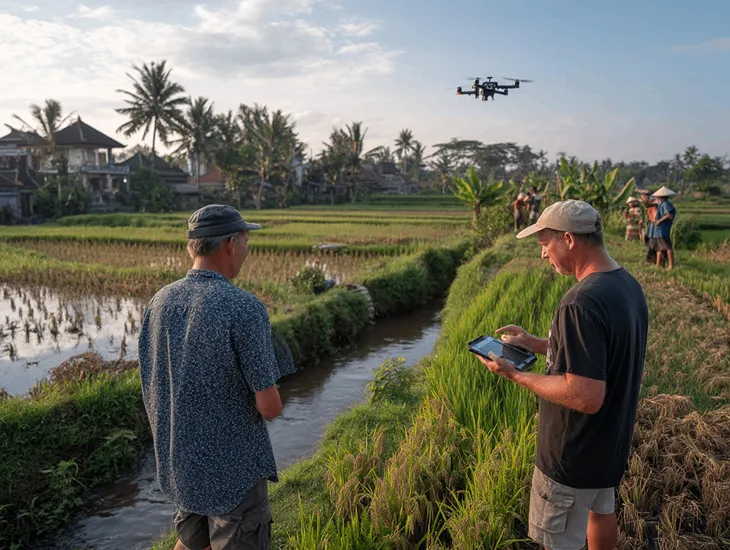
The risks of ignoring regulations near Subak-managed landscapes are substantial. Authorities are increasingly using satellite imagery and drone surveys to identify illegal structures.
Villas found in Green Zones face denial of utilities (electricity and water), hefty administrative fines, and ultimately, demolition orders.
A common mistake is assuming that because a neighbor has built a villa, the adjacent land is also buildable.
Enforcement is often sporadic, and existing buildings may be illegal or “grandfathered” in under old, now-defunct regulations. Relying on visual precedence rather than official zoning maps is a primary cause of investment failure.
Furthermore, conflict with the local community is a significant risk. If a construction project blocks an irrigation tunnel or pollutes the water source used by the subak irrigation network, the local Banjar and Subak organizations can halt construction immediately using customary laws, regardless of what paperwork the foreigner holds.
Community relationships are paramount in Bali, and disrespecting agricultural infrastructure is a quick way to lose your social license to operate.
Marketing Eco-Villas for Higher Revenue in Bali
When developed legally, villas with rice field views offer a high-value proposition. Marketing strategies should focus on “Eco-Living” and “Nature-Immersive” experiences.
Guests are willing to pay premium nightly rates for the tranquility and authenticity of staying near rice terraces in Bali, far away from the traffic of urban centers.
Successful operators leverage the view to create unique selling points, such as sunrise yoga decks facing the paddies or educational tours about the rice cycle.
However, marketing claims must remain honest. Listings should not promote “private rice fields” if the land is actually owned by local farmers, as this can lead to misunderstandings and trespassing issues.
Ensuring your marketing aligns with your legal reality protects your reputation. Promoting a “Luxury Villa in the Rice Fields” that lacks a tourism license exposes the business to tax audits and immigration checks, as authorities monitor platforms like Airbnb and Booking.com for non-compliant listings.
Special Exceptions and Eco-Tourism Opportunities
There are rare exceptions where building on or near agricultural land is permitted, but these are strictly controlled.
Genuine eco-tourism initiatives that support the preservation of rice terraces in Bali may be granted special permits.
These projects must align with conservation goals, often requiring low-impact structures (like bamboo) and zero-waste systems.
UNESCO-inscribed areas may offer technical support or funding for conservation-aligned business models, but they also come with strict caps on visitor numbers and building intensity.
These are not standard commercial villa projects but rather specialized ventures requiring deep integration with local stakeholders.
In some cases, housing for local residents is allowed on productive land to support the community, but this exception does not extend to commercial holiday villas for foreigners.
Investors should assume the strict rules apply unless they have obtained a high-level specific exemption from the regency government.
FAQs about Building Near Rice Fields
It is extremely difficult and rare. Zoning reviews happen every few years, but converting productive rice terraces in Bali to residential land is contrary to current provincial sustainability goals.
Setbacks vary by regency but typically range from 15 to 50 meters from a riverbank (sempadan sungai). For rice fields, you generally cannot build right up to the property line if it disrupts irrigation; a buffer is usually required.
Legally, no. Even semi-permanent structures intended for habitation or commercial use require permits that are not issued for Green Zones.
Always request an official ITR (Informasi Tata Ruang) or KKPR directly from the local Dinas PUPR (Public Works Department). Do not rely solely on online maps or agent assurances.
You inherit the liability. You may be unable to renew the lease, obtain an operating license, or sell the property later. In the worst case, the government can seize the land use rights or demolish the structure.
Yes. Besides the general 15-meter rule, areas near significant temples or cultural landscapes may have stricter height limits to preserve the visual skyline.