



Retiring in paradise is a dream for many, but the reality of navigating foreign regulations and finding the right community can quickly become overwhelming.
Many seniors arrive expecting a seamless transition, only to struggle with complex visa requirements, isolation in unsuitable neighborhoods, or the shock of inadequate medical access.
The lack of formal retirement communities in Bali often leaves retirees piecing together their own safety net in a foreign land.
The anxiety of choosing the wrong location—where traffic is chaotic or hospitals are an hour away—can turn your retirement into a logistical challenge.
Without clear guidance on where to settle and how to legally secure a long-term stay, your retirement fund and peace of mind are at risk.
The fantasy of island life requires practical grounding in infrastructure, legal compliance, and community support to be sustainable.
This guide provides a comprehensive look at the best neighborhoods and legal pathways for a comfortable life.
From the calm shores of Sanur to the cultural hills of Ubud, we break down the pros and cons of each area specifically for seniors. We also clarify the essential steps for obtaining your Retirement KITAS, ensuring your move is compliant with Directorate General of Immigration regulations.
Table of Contents
Understanding the Retirement KITAS (Lansia) Eligibility in Bali
Before packing your bags, securing the right legal footing is paramount. Indonesia offers a specific Retirement ITAS (often referred to as KITAS Lansia), designed for foreign nationals aged 60 and above (though some regulations may cite 55, enforcement in 2026 leans toward 60).
This visa strictly prohibits work; applicants must sign a statement confirming they will not engage in any business activities or employment while in the country.
To qualify, you must demonstrate financial independence, typically requiring proof of a monthly income (typically ranging from USD 1,500 to USD 3,000) or a substantial bank balance to ensure you are not a burden on the state.
Additionally, you must appoint a local sponsor, usually a licensed agency, and provide proof of health insurance valid in Indonesia. While formal, gated retirement communities in Bali with integrated visa services are rare, reliable agencies can bundle these administrative needs with your housing search.
Sanur: The Gold Standard for Senior Living
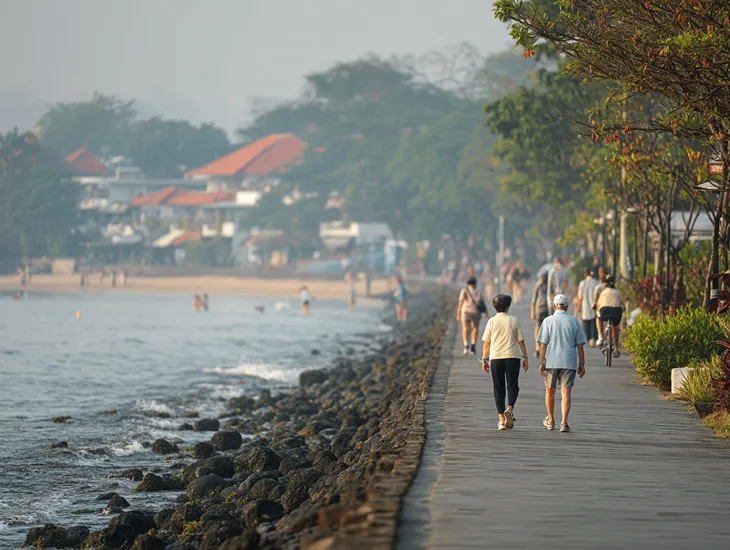
Sanur is frequently cited as the top choice for retirees, and for good reason. Unlike the chaotic traffic of Canggu or the steep terrain of the Bukit peninsula, Sanur offers a flat, walkable environment anchored by a paved beachfront promenade that stretches for kilometers.
This boardwalk is the social heart of the area, perfect for morning walks and cycling without the danger of aggressive motorbike traffic.
The infrastructure here is tailored to an older demographic. Sanur is home to the Bali Mandara Hospital and the new Bali International Hospital, providing world-class medical care within minutes of most residential streets.
The pace of life is slower, the waters are calm and reef-protected, and there is an established network of expats.
For those seeking the closest equivalent to Western retirement villages, Sanur’s clusters of serviced villas and active expat clubs offer a sense of safety and belonging that is hard to match elsewhere.
Ubud: Wellness, Culture, and Cooler Climates
For retirees who prioritize nature and spirituality over beaches, Ubud remains a magnetic draw. Located in the central uplands, it offers a cooler climate that can be more comfortable for those sensitive to the coastal heat.
The town is the epicenter of Bali’s wellness industry, offering endless options for yoga, meditation, and organic dining, which aligns well with a health-focused retirement lifestyle.
However, potential residents should be aware of the logistical challenges. Ubud’s terrain is hilly, and many villas are accessible only via steep steps or narrow paths that may not be suitable for those with mobility issues.
While there are decent local clinics, major hospitals are a 45-to-60-minute drive away in Denpasar.
While you won’t find walled retirement communities in Bali here, the tight-knit expat community provides a strong social safety net, often organizing cultural events, book clubs, and communal dinners.
The South Bali Debate: Seminyak vs. The Bukit
The lifestyle choice in South Bali often splits between the convenience of Seminyak and the tranquility of the Bukit Peninsula.
Seminyak and its neighbor Kerobokan offer a cosmopolitan retirement with easy access to high-end dining, shopping, and pharmacies.
It is walkable in parts but suffers from heavy traffic. This area suits active retirees who want to remain in the “thick of it” and value having urban amenities on their doorstep.
Conversely, the Bukit (areas like Jimbaran, Ungasan, and Nusa Dua) offers dramatic sea views and a resort-style atmosphere.
It is quieter and boasts some of the island’s best beaches. However, it is largely car-dependent. Amenities are spread out, meaning you will likely need a driver or a car to do groceries or visit the doctor.
While not marketed explicitly as retirement villages, the luxury villa clusters in Nusa Dua offer high security and paved roads, mimicking the gated community feel many retirees desire.
Real Story: Margaret’s Move from Isolation to Community in Bali
For Margaret, a 64-year-old former teacher from Manchester, the jungle north of Ubud was supposed to be a sanctuary. The lush greenery and the sound of the river were mesmerizing—until the rains began.
The dirt track leading to her villa turned into an impassable river of mud. Isolated in her “paradise,” Margaret found herself staring at the rain for days on end, the solitude slowly turning into a deep, anxious loneliness. The romantic seclusion she had paid for was now a cage.
Struggling with the logistics of setting up reliable internet and finding a driver who could navigate the mud, Margaret felt defeated.
That’s when she approached a professional management team to rethink her living situation. She needed accessibility, not just aesthetics. She transitioned to a serviced villa cluster in Sanur, where she had paved access, 24/7 security, and neighbors her own age. “I didn’t realize how much I needed a community until I didn’t have one,” she admitted.
By moving to a neighborhood that functioned like one of the informal retirement communities in Bali, Margaret traded isolation for a vibrant, supported lifestyle.
Navigating Property Options: Leasehold vs. Rental

Foreign retirees generally cannot own freehold property in Indonesia. The most common path is a long-term leasehold (Hak Sewa) or a prepaid rental agreement.
Leaseholds typically run for 25 to 30 years and allow you to treat the property as your own, including making renovations.
This is a popular option for those who want stability without the complexity of setting up a foreign investment company (PT PMA).
Alternatively, many retirees opt for yearly rentals to maintain flexibility. This “lock-and-leave” lifestyle allows you to test different neighborhoods before committing.
Some developers are now building serviced apartment complexes specifically targeting the senior market, offering housekeeping, maintenance, and concierge services included in the rent.
While these are not officially registered retirement communities in Bali, they effectively serve the same function, providing a hassle-free living environment where the heavy lifting of home maintenance is managed for you.
Healthcare Infrastructure and Insurance Essentials
Healthcare is the single most critical factor for retiring in Bali. While the island’s medical infrastructure has improved drastically, it varies by region.
The south (Sanur, Kuta, Nusa Dua) hosts internationally accredited hospitals like Siloam and BIMC, capable of handling emergencies and complex surgeries.
If you choose to live in remote areas like North Bali or East Bali, you must factor in the travel time to these facilities during an emergency.
Comprehensive health insurance is not just a visa requirement; it is a financial survival tool. Local healthcare for foreigners is unsubsidized and can be expensive.
Policies should specifically cover medical evacuation, as serious conditions may require transport to Singapore or Bangkok.
When evaluating potential retirement communities in Bali or neighborhoods, always test the drive time to the nearest 24-hour emergency room—it is a metric that matters more than the view.
Key Risks and Common Mistakes for Retirees
A common mistake is assuming that “retirement” implies a lack of regulation. Some retirees inadvertently break the law by engaging in casual work, such as consulting online or renting out a room in their villa.
The terms of the Retirement KITAS are strict: zero work is permitted. Violations can lead to deportation. Another risk is signing a lease for a property on land with disputed zoning, which can lead to eviction.
Furthermore, many newcomers underestimate the cost of a “western standard” lifestyle. While local food is cheap, imported wine, cheese, and quality electronics are heavily taxed.
Relying on a fixed pension without a buffer for currency fluctuations (IDR vs. USD/EUR/AUD) can be dangerous. Finally, do not fall for marketing that labels a project as a “government-backed retirement village.”
In 2026, most retirement communities in Bali are private commercial developments; always verify the developer’s track record and the legal status of the land before handing over your retirement savings.
FAQs about Bali Retirement Villages
No, there are no government-run retirement villages. The options available are private villa complexes or apartments that cater to seniors with added services like security and maintenance.
The regulation generally stipulates a minimum age of 60 years old for the dedicated retirement visa, though some specific sponsor packages may have different criteria based on current policy.
Foreigners cannot own freehold land. You can acquire a property through a long-term leasehold (typically 25+ years) or a Right to Use (Hak Pakai) title if you meet the specific residency and value thresholds.
Sanur is widely considered the best all-around neighborhood for retirees due to its walkability, access to international hospitals, calm beaches, and established senior expat community.
Yes, proof of valid health insurance and life insurance is a mandatory requirement for obtaining and renewing your Retirement KITAS in Indonesia.
While visa requirements may state a lower minimum (e.g., USD 1,500), a comfortable lifestyle in 2026 typically requires USD 2,500 to USD 3,500 per month to cover decent housing, insurance, and leisure.