



The 2025-2026 rainy season in Bali has brought intensified weather patterns, making robust safety measures non-negotiable for property owners. From sudden flash floods in urban areas to severe roof leaks that threaten electrical systems, the risks to guests and investment assets are real and escalating. Ignoring these hazards can lead to significant financial loss and potential legal liability under Indonesian negligence laws.
Implementing a comprehensive response plan is the only way to ensure business continuity and guest safety during extreme weather events. By integrating island-wide alerts from government bodies like BNPB with localized standard operating procedures (SOPs), you can mitigate damage before it spirals out of control. This guide outlines the essential steps to professionalize your crisis management strategy.
Table of Contents
Understanding the Regulatory Landscape in Bali
Navigating the legal framework is the first step in establishing compliant Bali emergency protocols: rainy season edition. The National Agency for Disaster Countermeasure (BNPB) sets the high-level regulations, while the Regional Disaster Management Agency (BPBD) Bali executes these at the provincial level. BPBD Regulation No. 7/2023 mandates standardized data reporting for disaster events, implying that commercial properties, including private villas, must align their safety measures with official standards.
For foreign investors, it is crucial to understand that there are no exemptions for private villas regarding safety compliance. Whether you run a small guesthouse or a luxury estate, the expectation is that you monitor official channels and maintain a safe environment. Failure to demonstrate “reasonable care”—such as having rehearsed evacuation routes or basic first aid availability—could be used against an owner in litigation following a guest injury during a storm.
Monitoring Systems and Early Warnings

Proactive monitoring is the backbone of effective Bali emergency protocols: rainy season planning. Reliance on casual observation is insufficient; owners must assign a dedicated staff member or manager to check official warnings daily. The Meteorology, Climatology, and Geophysics Agency (BMKG) issues early warnings for heavy rain, strong winds, and high waves. These alerts should be logged in a simple operational diary to prove due diligence in case of an incident.
Villas should define specific “trigger levels” that automatically activate internal safety modes. For instance, a “Yellow Alert” from BMKG regarding high winds should trigger an immediate inspection of roof tiles and the securing of outdoor furniture. Recent reports from The Bali Sun highlighted that the 2025/2026 season would see extreme hydrometeorological risks, reinforcing the need for real-time situational awareness rather than reactive scrambling.
Managing Severe Leaks and Structural Failures
Water ingress is the most common operational emergency during the rainy season. BPBD Bali frequently records “damaged buildings” and “temporary waterlogging” as major incident categories. A minor drip can escalate into a ceiling collapse or electrical fire within hours if not managed correctly. Your protocol must prioritize immediate life safety over property preservation in the first hour of a severe leak.
The standard procedure for a severe leak begins with electrical isolation. Staff must know exactly which breakers control the affected zone to prevent short circuits. Once the area is safe, the focus shifts to containment—using heavy-duty tarps to divert water and buckets to collect runoff away from structural joints. Repair work, such as emergency roofing or drainage clearing, should only be commissioned once the immediate storm threat has passed (typically 24-72 hours later) to ensure the safety of the workers.
Guest Safety Communication Strategies
Clear communication prevents panic. Foreign guests may not be familiar with tropical storms or the sounds of intense rainfall on a tiled roof. Your Bali emergency protocols: rainy season strategy must include pre-written templates in English and Indonesian that can be sent via WhatsApp or email the moment an official alert is issued. These messages should calmly explain the situation, advise guests to stay indoors, and provide emergency contact numbers.
Transparency builds trust and reduces liability. If a storm is predicted, inform guests beforehand about potential power outages or noise. Provide them with a printed “In-Villa Emergency Guide” that lists the location of flashlights, first aid kits, and the assembly point. This proactive approach demonstrates professionalism and reassures guests that their safety is being actively managed by a competent local team.
Real Story: Protecting Guests During the Monsoon in Bali
At 2:00 AM in Pererenan, the sound of tropical rain changed from a rhythmic patter to a heavy, metallic thud. That was the moment Sarah’s box gutter failed. A concealed blockage caused water to overflow instantly, cascading down the industrial concrete walls of her living room and pooling dangerously close to the sunken lounge’s recessed floor outlets.
Watching the CCTV feed from her home in Melbourne, Sarah felt a sickening pit in her stomach. She could see her guests—a Swedish family with small children—standing in ankle-deep water, frantically using bath towels to stem the flow near live electrical sockets. They were calling out, but the night security was on the perimeter and couldn’t hear them over the storm. The industrial aesthetic she loved—the polished concrete and minimalist lighting—had suddenly become a liability without a storm-proof SOP.
Desperate to prevent a tragedy, Sarah contacted Bali Visa’s consulting team the next morning to restructure her management approach. We helped her implement a “Rapid Response Protocol,” establishing a direct 24/7 line between guests and a bilingual emergency manager, and installing simple leak sensors in critical roof cavities. Two weeks later, when another heavy storm hit, the system worked: sensors triggered an alert, staff arrived in 20 minutes to isolate power and deploy heavy-duty water barriers, and the guests slept through the night.
Essential Disaster Supply Kits
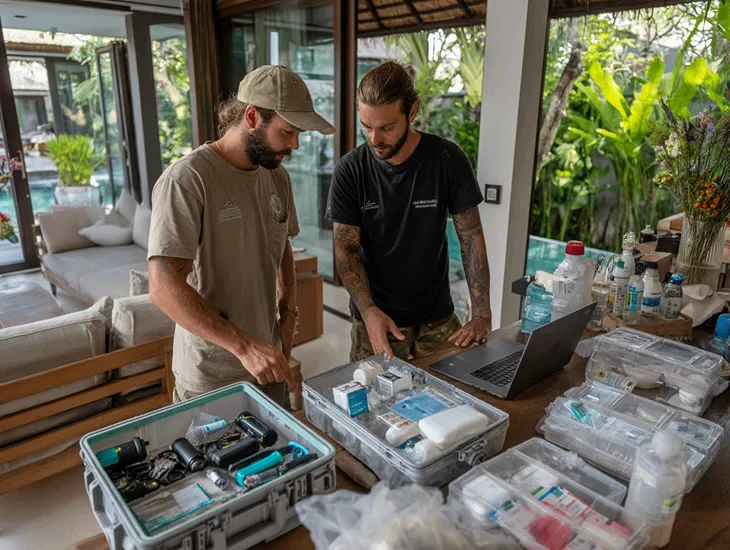
Elara’s manager didn’t find a guest at check-out; he found a crime scene. A custom-built 65-inch Smart TV had been ripped from the wall, leaving behind exposed wires and crumbling plaster. The sliding glass doors—specially imported for their soundproofing—were shattered.
The most stressful part? The guests had already cleared immigration at Ngurah Rai Airport by the time the damage was discovered. They had blocked Elara’s number, and Airbnb’s automated system was stuck in a loop asking for “police-verified evidence” and original purchase invoices she didn’t have on hand. Elara felt powerless, facing a $5,000 repair bill with zero cooperation from the platform.
We stepped in to bridge the gap. Within four hours, we had a Polsek Kuta Selatan officer on-site to issue a formal Surat Kehilangan, the crucial document for any theft claim. By bypassing the ghosting guests and going straight to her Property All Risk provider with a “Pre-Check-In Video” as proof, we secured a payout that covered not just the repairs, but also the three days of “Business Interruption” while the glass was being replaced. The deductible was only $350—a small price to pay for recovering nearly $4,650 in damages.
Insurance Documentation and Liability
The aftermath of a disaster is often an administrative battle. Insurance providers in Bali are increasingly strict regarding claims for water damage and “Acts of God.” They often require proof that the property was well-maintained and that reasonable steps were taken to mitigate damage during the event. Without a documented timeline of actions taken—photos of the leak as it started, timestamps of staff intervention, and logs of official warnings—your claim could be denied.
Effective protocols integrate documentation into the response itself. Staff should be trained to take short videos and photos of the damage safely before cleanup begins. This visual evidence, combined with your log of BMKG alerts, proves that the damage resulted from an extraordinary event despite your best efforts. This documentation is also critical for protecting yourself against negligence claims if a guest’s personal property is damaged.
Post-Disaster Recovery and Repairs
Recovery is not just about fixing what is broken; it is about restoring guest confidence and operational readiness. Once the immediate danger has passed, a thorough inspection of the property is required. This goes beyond visible damage; checking for hidden mold growth in ceiling cavities and testing electrical circuits with a qualified technician are mandatory steps before re-opening affected rooms to guests.
Engaging reliable contractors during the rainy season can be difficult due to high demand. Pre-qualifying tradespeople—roofers, electricians, and plumbers—who offer emergency call-out services is a smart preparation strategy. Establishing these relationships before a crisis ensures you are not at the mercy of inflated “emergency” pricing and allows your villa to return to the market faster than competitors who are still scrambling for help.
FAQs about Emergency Protocols
While there is no single "villa emergency act," general regulations under BNPB and tourism standards regarding guest safety imply a legal duty of care. Failing to have a plan can result in liability for negligence under the Indonesian Civil Code if a guest is injured.
It is best practice to check flashlights, fire extinguishers, and first aid kits monthly. A full drill involving staff, simulating a severe leak or evacuation, should be conducted at least once before the peak rainy season begins (around October or November).
Staff should immediately secure loose outdoor items, clear drainage points of debris, and ensure all windows and doors are sealed. They should also verify that the backup generator is fueled and operational in case of power grid failure.
While the banjar is helpful, they are often overwhelmed during island-wide disasters. Your Bali emergency protocols: rainy season plan must be self-sufficient for at least the first 24 hours, relying on your own supplies and staff before external community aid arrives.
Use a calm, direct approach. Inform them immediately if an official warning is issued by BMKG, guide them to the designated "Higher Ground" evacuation point marked on your villa map, and advise them to leave their belongings behind to prioritize life