



Foreign property owners often underestimate the true financial reality of operating a luxury rental property in Indonesia. They focus entirely on projected booking revenue while completely ignoring the complex logistics of paying monthly utility bills. This lack of financial oversight quickly leads to missed payments, sudden utility disconnections, and incredibly frustrated guests.
Operating without a structured financial system allows seemingly minor expenses to leak and gradually erode your overall profitability. A sudden spike in electricity from a malfunctioning pool pump can easily consume your entire profit margin for the month.
When remote owners try to manage these local accounts independently, they often face significant language barriers and confusing local banking protocols.
Implementing a rigorous system for managing villa costs in Bali is the only reliable way to protect your long-term investment. By establishing clear payment workflows and realistic operational budgets, you transform your property into a stable, highly profitable business.
We advise following official Indonesian financial guidelines to ensure all your corporate accounting meets required national standards.
Operating efficiently requires a deep understanding of local billing cycles and the specific consumption drivers within your luxury property. You must align your financial expectations with realistic market data to avoid unpleasant surprises during the peak tourist season.
This structured approach eliminates financial anxiety and ensures your property always remains a premier destination for travelers.
Adhering to strict cost control measures is absolutely essential for maximizing the true return on your luxury investment.
A well-organized budget ensures that routine maintenance is fully funded, preventing minor issues from escalating into major structural failures. Professional oversight is the foundational pillar upon which all other operational upgrades and revenue strategies must be built.
Specialized management for villa costs in Bali provides the technical tools and local expertise required for absolute peak performance. This structure ensures your property remains a completely passive, profitable, and secure investment for many years to come.
Your property becomes a seamless operation where every financial detail is handled with absolute professional precision and care.
Table of Contents
Core monthly ranges for property upkeep
Understanding realistic financial benchmarks is the crucial first step for anyone entering the Indonesian luxury property market. For a typical two to three-bedroom property, electricity often ranges between 800,000 to 2,500,000 Rupiah monthly. This wide variance depends heavily on guest behavior, air conditioning usage, and the efficiency of your specific pool pumps.
Water supply, whether through the municipal PDAM system or delivered via truck, usually costs between 300,000 and 600,000 Rupiah. High-speed fiber internet, which is absolutely mandatory for attracting digital nomads, typically adds another 300,000 to 1,000,000 Rupiah. You must also account for essential banjar contributions and local garbage collection, which run around 100,000 to 300,000 Rupiah.
Routine service contracts for private pools and lush tropical gardens commonly range from 800,000 to 1,800,000 Rupiah monthly. Overall, total operational expenses for a fully serviced property often consume thirty to fifty percent of your gross rental income. Accurately projecting these villa costs in Bali prevents cash flow issues and ensures your business remains solvent year-round.
Understanding utility systems for rentals in Bali

The national electricity provider, PLN, operates via two primary systems: prepaid token meters and traditional postpaid monthly billing. Prepaid meters are highly popular for short-term rentals because they force active monitoring of energy consumption by the management team. Postpaid accounts require strict discipline, as bills must typically be paid by the twentieth of each month to avoid disconnection.
Water supply via the municipal PDAM company is billed based on cubic meter usage, with rates varying significantly by district. In areas where the municipal infrastructure is weak, owners must rely partially on expensive delivered water trucks to maintain supply. Managing these dual systems requires constant vigilance to ensure guests never experience a sudden loss of water pressure.
Internet invoices are usually billed monthly, with many local providers aligning their due dates closely with the PLN schedule. Payments are typically handled via direct bank transfer, virtual accounts, or popular Indonesian e-wallet applications. Understanding how these specific systems operate is vital for managing villa costs in Bali effectively without service interruptions.
Payment methods for remote property owners
For overseas investors, the primary financial goal is to avoid missed deadlines while maintaining total control over the operational budget. Modern digital applications like PLN Mobile and various Indonesian e-commerce platforms allow owners to pay bills from absolutely anywhere. However, accessing these convenient platforms often requires setting up a verified Indonesian bank account or a compatible local payment method.
Many of these advanced applications allow you to group recurring bills and pay them simultaneously in one single transaction. This significantly reduces the administrative burden of tracking multiple due dates across different service providers throughout the busy month. However, navigating these apps independently can be challenging if you are not fluent in the local Indonesian language.
Community guidance strongly suggests tracking due dates carefully: PLN is typically due around the twentieth, and PDAM around the twenty-fifth. Annual property taxes, known locally as PBB, have varying deadlines that must be monitored closely to avoid severe government penalties. Professional support ensures these critical payments are never missed, protecting your asset from unnecessary legal or operational complications.
Systems to control operating expenses in Bali
Strong property operators treat utility bills and running expenses as highly controllable variables, not just random acts of fate. The first step is to separate all expenses into distinct, trackable categories: electricity, water, internet, and minor routine maintenance. This detailed categorization allows you to identify exactly where your money is going and spot potential inefficiencies quickly.
Compare your actual monthly spending against the established industry benchmarks to identify any sudden, unexplained financial spikes immediately. A sudden surge in water costs often signals a hidden underground leak or a malfunctioning toilet that requires immediate repair. Catching these mechanical issues early prevents massive bills and protects your overall return on investment significantly.
Implementing strict usage policies and utilizing smart hardware drastically reduces your monthly energy consumption. Installing simple timers on pool pumps and utilizing energy-efficient appliances lowers your baseline operating expenses without impacting guest comfort. Controlling these villa costs in Bali is the secret to maintaining high profitability during the slower low tourist seasons.
Real Story: Surviving a utility billing crisis
Marcus, an investor from Munich, sat in his home office staring blankly at an incredibly threatening email from his property manager. His newly completed luxury property in Pererenan was fully booked for the entire upcoming month of August. However, the email stated that the local electricity provider was threatening immediate disconnection due to three months of unpaid bills.
The cold German morning felt entirely disconnected from the humid, stressful reality of navigating the complex Indonesian billing system. He had relied on an informal local contact to handle the physical cash payments, but that contact had suddenly disappeared. The terrifying thought of having to refund thousands of dollars to furious guests sent a wave of absolute panic through him.
That is exactly when Marcus hired our professional management team to instantly restructure his villa costs in Bali. We immediately settled the outstanding balances digitally and transitioned his property to a fully transparent, centrally managed payment system. Marcus now reviews clear monthly financial statements from Germany, completely free from the anxiety of sudden utility disconnections.
Optimizing revenue through smart house rules
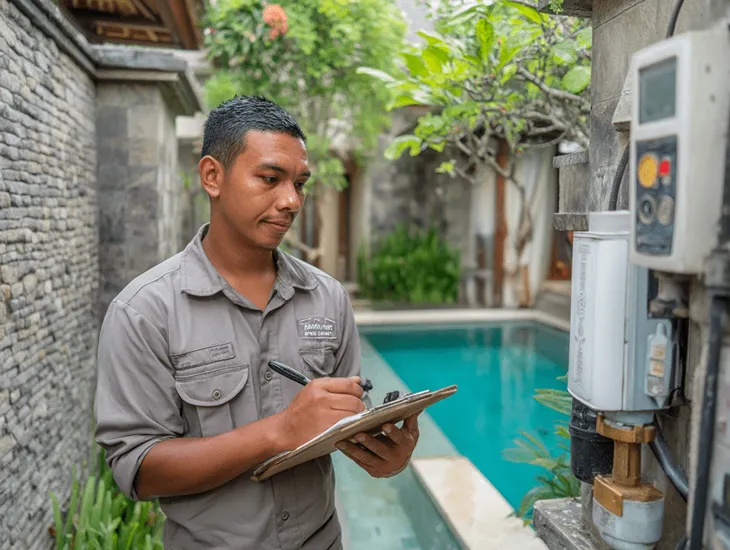
For short-term rentals, establishing clear house rules regarding reasonable energy use is a highly effective cost-control strategy. Many operators politely request that guests turn off the air conditioning when they leave the property for daily excursions. This simple communication strategy significantly reduces unnecessary energy consumption while promoting an eco-friendly image for your brand.
Some advanced operators even consider including a generous, fair-use electricity allowance built directly into their nightly rental rates. If a guest exceeds this clearly defined threshold, a reasonable surcharge is automatically applied to their final bill. This strategy protects your profit margins from travelers who leave every AC unit running continuously with the doors open.
Communicating these specific policies clearly before the guest arrives prevents misunderstandings and negative reviews upon checkout. When guests understand that conservation efforts protect the local environment, they are usually very willing to cooperate fully. Smart house rules are a totally free method for effectively controlling your monthly villa costs in Bali.
Planning reserve budgets for major capex
Professional property guidance strongly recommends explicitly budgeting for major capital expenditures, commonly known as capex, well in advance. The harsh tropical climate aggressively accelerates the wear and tear on essential components like roofing, exterior paint, and waterproofing. Ignoring these inevitable major repairs will completely destroy your operational budget when multiple systems fail simultaneously.
You should actively set aside a specific percentage of your monthly rental income into a dedicated reserve maintenance fund. This fund ensures you always have the immediate liquidity required to replace a broken AC unit or repair a leaking roof. Having cash ready prevents you from taking on expensive emergency debt during the slower, low-occupancy tourist seasons.
A well-funded reserve budget allows you to maintain the premium aesthetic of your property year after year effortlessly. Properties that look continuously fresh and newly renovated always command the highest nightly rates on major booking platforms. Strategic financial planning is the absolute cornerstone of a highly resilient and profitable luxury property investment business.
The role of professional management fees
Outsourcing your financial logistics to a professional agency eliminates the daily stress of tracking endless utility due dates. Management fees typically wrap cost handling into their overall commission, handling everything from bill payments to staff scheduling completely. While the utility costs themselves are passed through to the owner, the administrative burden is entirely removed.
Management packages are commonly charged as a percentage of your total rental income, perfectly aligning the agency’s goals with yours. This fee structure ensures that the management team works aggressively to maximize your occupancy and maintain your property perfectly. The cost of professional oversight is easily offset by the resulting increase in revenue and the reduction of wasted expenses.
Owners must clarify exactly who pays which utilities and whose specific name is registered on the official meters. You should also demand clear answers regarding how bills are approved and how often detailed financial reports are sent. Transparent accounting from a trusted partner is the ultimate key to managing villa costs in Bali successfully.
FAQs about villa costs in Bali
A typical property costs between 800,000 and 2,500,000 Rupiah monthly, depending heavily on AC and pool usage.
Professional management agencies handle all local payments and pass the exact costs through in detailed monthly statements.
Yes, relying on delivered truck water typically adds an extra 200,000 to 400,000 Rupiah to your monthly budget.
Prepaid meters are highly recommended because they force active monitoring and completely prevent surprise billing spikes.
No, management fees cover the administration, but the actual villa costs in Bali are paid by the owner.