



As we navigate through 2026, the Island of the Gods is experiencing a dual reality: booming tourism numbers and a stringent regulatory correction. While international arrivals have surged—surpassing 16 million total visitors recently—the days of speculative, unregulated development are firmly over.
Investors relying on outdated advice are finding themselves with assets that generate high revenue but face existential legal threats.
The current property market forecast in Bali indicates that success now depends entirely on aligning with government spatial planning and evolving guest preferences.
The anxiety for many foreign investors stems from the “Wild West” narrative coming to an abrupt halt. Provincial authorities have begun sealing non-compliant villas in Green Zones and blocking short-term rental licenses for properties in residential-only clusters.
Seeing a neighbor’s active construction site halted by Satpol PP is a stark reminder that the rules have changed. The risk of holding an unlicensable asset is now the primary concern, overshadowing even occupancy struggles.
To succeed in this maturing market, one must adopt a compliance-first strategy. The data points towards a robust future for those who play by the rules, with emerging regions like
Tabanan and Pererenan projecting capital growth of 8–10%. This article breaks down the essential trends, from the shift toward compact living to the critical legal structures required for safety.
For official tourism statistics driving these trends, refer to the Ministry of Tourism and Creative Economy data portal.
Table of Contents
Bali Tourism Resurgence and Demand Drivers
The engine of Bali’s economy is firing on all cylinders again. Following a strong recovery in 2024, the momentum has carried well into 2026, with international arrivals recording double-digit growth year-on-year.
This influx does not just consist of short-term holidaymakers; there is a structural expansion in the “digital nomad” and long-stay retiree segments. The current property market forecast in Bali highlights the importance of professional property management. These services ensure high guest satisfaction and consistent rental income for villa owners.
These groups are driving consistent demand for high-quality accommodation in areas equipped with reliable infrastructure, international schools, and healthcare.
This diverse demand profile stabilizes the investment landscape. While tourists fill the calendar during peak seasons, the growing expat community provides a buffer during shoulder months.
However, their expectations have evolved. They demand fiber-optic internet, ergonomic workspaces, and legal security—factors that are now non-negotiable for maintaining high occupancy rates.
Price Trends: Saturated vs. Emerging Zones
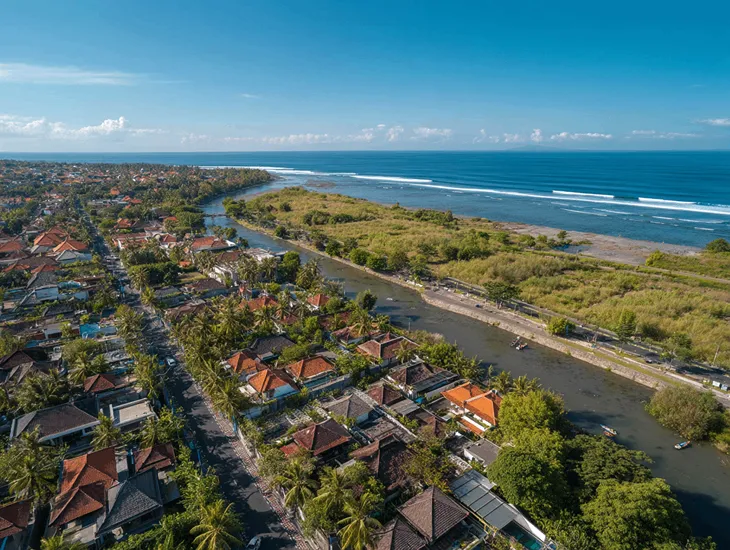
Market reports for 2026 highlight a divergence in capital appreciation. Overall, the island is seeing a healthy 5-year price growth average of around 7% annually.
However, the property market forecast in Bali shows that prime areas like Seminyak and central Canggu are experiencing slower growth due to saturation.
In these hubs, high land prices compress yields, making it harder for new entrants to achieve the ROI seen in previous years.
In contrast, emerging regions are outperforming the average. Areas such as Pererenan, Bingin, and the coastal stretches of Tabanan are witnessing capital growth in the 8–10% range.
This acceleration is tied to infrastructure improvements, including new road networks that reduce travel time from the airport.
Investors are increasingly looking north and west to capture this early-stage value before these prices equalize with the south.
The Shift to Compact and Long-Stay Living in Bali
The era of the sprawling 6-bedroom party villa is waning. Trend analyses for 2026 indicate a sharp pivot towards compact, highly efficient units.
Rising construction costs and a shift in traveler demographics—favored by solo nomads and couples—have made 1-bedroom and 2-bedroom private pool villas the highest-yielding asset class.
These units require less land, have lower operating costs, and consistently achieve higher occupancy percentages.
Furthermore, market analysis suggests a strengthening of the long-stay rental market. With the formalization of long-term visa options, more guests are seeking monthly or yearly rentals.
Co-living spaces and villas designed with community features are seeing strong performance. While average revenue for generic mid-sized villas has dropped due to competition, specialized compact units and long-stay setups are holding their value.
Regulatory Crackdowns: The End of the Wild West
The most significant shift in 2026 is the enforcement of zoning laws. The government’s “OSS-PBG integration” means that obtaining a building permit (PBG) or a tourism license is now systematically blocked if the land zoning does not match the business activity.
We have seen task forces actively audit permits, leading to the sealing of villas in Green Zones (agricultural land) that were illegally marketed as rentals.
This crackdown effectively bifurcates the market. On one side are compliant, licensed properties that can trade freely on major platforms.
On the other are “grey market” assets that face constant risk of closure. The property market forecast in Bali warns that properties without proper zoning (Pink/Tourism zones) will face severe liquidity issues, as smart buyers and platforms now require proof of compliance before transacting or listing.
Real Story: A Compliance Pivot in Seseh
In late 2024, Liam stood at a crossroads. A 45-year-old developer from Perth, he was evaluating two potential investments. To his left was a glamorous cliffside plot in Bingin; to his right, a quieter, cheaper plot in Seseh.
The Bingin plot promised prestige and astronomical daily rates, but the Seseh plot promised legality.
Liam decided to trust data over hype. A zoning check revealed the Bingin land was a regulatory trap—residential zoning that precluded legal short-term rental licenses. He chose the Seseh plot, which sat firmly in a tourism zone.
Two years later, the difference is stark. Liam’s Seseh villas are fully licensed and generate secure 12% returns, while the “residential” developments in Bingin are facing platform bans and government seals. Liam didn’t just buy land; he bought longevity.
Bali Investment Structures for Foreigners

Foreigners must navigate the legal landscape with precision. The cornerstone rule remains: foreigners cannot own Hak Milik (Freehold). The credible path for a secure investment in this market involves using a PT PMA (Foreign Investment Company).
This entity allows investors to hold Hak Guna Bangunan (HGB) or lease rights commercially, ensuring the business is fully tax-compliant and eligible for tourism licenses.
For those seeking a personal residence without rental income, Hak Pakai (Right to Use) is a viable option, granting a long-term title over the land. However, the hybrid model—buying a personal lease and secretly renting it out—is now a high-risk strategy.
Authorities are cross-referencing tax data with OTA listings, identifying and penalizing owners who bypass the PT PMA requirement.
Key Risks: Zoning and Revenue Compression
Zoning risk is the central theme of the 2026 property market forecast in Bali. Many legacy investors are stuck with assets in Green Zones that can no longer be legalized.
These properties are structurally unsafe investments, facing demolition orders or permanent inability to trade. Due diligence on RDTR (Detailed Spatial Plan) maps is now the first step in any transaction.
Additionally, revenue compression is impacting generic stock. As supply increases in popular areas, villas that lack differentiation—branding, design, or niche targeting—are forced to compete on price.
This “race to the bottom” erodes yields. Investors relying on pre-pandemic pricing assumptions are finding their actual returns are significantly lower than projected, underscoring the need for conservative underwriting.
Future Hotspots: Beyond the South
As the south becomes saturated, the market outlook points to the north and east as the next frontiers. Infrastructure projects, including improved cross-island roads, are opening up inland areas and coastal towns previously considered too remote.
A reliable property market forecast in Bali suggests that land values in the north will rise steadily. Investors are securing plots now to benefit from upcoming infrastructure projects. These locations offer lower entry points and the potential for higher capital appreciation as development spreads.
Eco-resorts and wellness retreats in these quieter zones are gaining traction, aligning with the government’s push for sustainable tourism.
While the timeline for major projects like the North Bali airport remains unconfirmed, the organic growth in these regions is undeniable.
Early movers who secure compliant land in these corridors are positioned to capture the next wave of value growth.
FAQs about Bali Property Market
Yes, but only if you follow a "compliance-first" approach. The property market forecast in Bali is positive for legally structured assets in correct zoning, while non-compliant properties face high risks.
No. Running a short-term rental is considered a commercial activity. You need a business entity (PT PMA) and specific licenses to operate legally and avoid tax penalties.
Emerging areas like Pererenan, Seseh, and Kedungu are projected to see 8–10% capital growth, outperforming saturated hubs like Seminyak.
Buying land in the wrong zone (Green or Residential-only) which prevents you from obtaining the necessary tourism licenses to rent the property out daily.
Yields are tightening in saturated areas due to competition but remain high (10-15%+) for well-managed, differentiated properties in emerging hotspots.
No. The law has not changed. Foreigners cannot own a freehold (Hak Milik). You must use Leasehold or Hak Pakai/HGB structures.