



The island dream can dissolve in an instant when a guest suffers a scooter accident in Uluwatu or a severe allergic reaction in Ubud at 3:00 AM. For foreign investors, the assumption that a printed list of phone numbers constitutes safety is a dangerous oversight.
In 2026, the gap between a “self-managed” villa and a professional operation is defined by the ability to mobilize help immediately. Relying solely on the public 112 system, which can face language barriers and delays, exposes your guests to unnecessary risk and your business to significant liability.
Failing to provide adequate support does more than just endanger lives; it creates a legal and reputational minefield. Under Indonesian consumer protection principles, guests renting a private villa expect a duty of care comparable to a hotel. If a crisis occurs and your staff are unreachable or untrained, you face negligence claims and devastating social media fallout. The isolation that makes your villa attractive becomes its biggest liability during a medical or security emergency.
The solution is to build a robust, three-layer safety ecosystem. This involves establishing a dedicated 24/7 contact point, mapping local emergency assets, and formalizing partnerships with private medical evacuation providers. By implementing a professional Bali villa emergency assistance protocol, you ensure that help is never more than a phone call away. Many owners partner with an established villa management firm to provide this round-the-clock emergency command center and safety net, ensuring compliance and peace of mind.
Table of Contents
The Core Emergency Ecosystem in Bali
To build a safety net, you must first understand what is available on the ground. Bali’s public emergency infrastructure has improved, but it remains fragmented compared to Western standards. The general emergency number is 112, which theoretically connects to police, fire, and medical dispatch. Specific direct lines include 110 for Police, 113 for Fire, and 118 or 119 for Ambulance services. However, response times for these public services are unpredictable and vary drastically depending on traffic and the specific regency (Badung, Gianyar, etc.).
For tourists, the private sector often provides a faster and more reliable lifeline. International-standard hospitals like BIMC, Siloam, and SOS Medika operate 24/7 emergency rooms and dispatch their own ambulances, which are equipped with English-speaking paramedics. Additionally, specialized Search and Rescue (SAR) teams and Balawista lifeguards operate in coastal zones. Your Bali villa emergency assistance plan must prioritize these private, reliable options over the general public numbers to ensure speed and clarity during a crisis.
Defining 24/7 Support for Private Villas

“Round-the-clock” support means more than just leaving a mobile phone on a nightstand. It requires a dedicated triage system. For a private villa, this means having a single, designated emergency number (WhatsApp and Voice) that is monitored actively 24 hours a day. This line should not just ring a sleeping security guard; it should connect to a duty manager capable of making executive decisions, authorizing transport, and communicating in both English and Bahasa Indonesia.
This layer of support acts as the bridge between the panicked guest and the local services. Whether it is a fire, a break-in, or a medical issue, the guest should only need to make one call. Your designated responder then activates the appropriate external services. This reduces guest anxiety and ensures that the location details given to the ambulance or police are accurate, avoiding the common issue of drivers getting lost in Bali’s winding alleyways (known locally as ‘gangs’).
Mapping Local Medical and Police Resources
Every villa location requires a bespoke “Emergency Map.” You cannot rely on a generic list of Bali hospitals; traffic conditions in 2026 mean that a hospital ten kilometers away might be an hour’s drive. You must identify the nearest 24/7 clinic for minor injuries and the nearest international hospital for major trauma for each specific property. Record the exact address, phone number, and a pinned Google Maps link for each.
Similarly, identify the nearest police post (Polsek) and tourist police station. In areas like Canggu or Seminyak, the tourist police are often better equipped to handle foreign-related incidents than the general police. This localized data should be printed on a laminated “Panic Card” kept in the villa and integrated into your digital guest guide. This preparation saves critical minutes when adrenaline is high and rational thinking is low.
Partnering with Private Evacuation Teams
For serious incidents, a ground ambulance may not be enough. Bali’s geography often necessitates medical evacuation (medevac) to a major hospital or even to Singapore or Australia. Professional villa operators should formalize relationships with air and ground evacuation providers like SGI Air Bali or Nusa Medica. These companies offer subscription or on-demand services that coordinate complex transfers, including helicopter retrieval from remote areas.
While you do not need to pay for these services upfront, you must know their activation protocols. Who do you call first? What insurance details do they need? Having a pre-established Bali villa emergency assistance workflow with these providers means you can advise the guest’s family or insurance company immediately, preventing delays in life-saving transport. This level of preparedness is a hallmark of luxury hospitality and significantly reduces your liability exposure.
Internal SOPs: Staff Training and Escalation
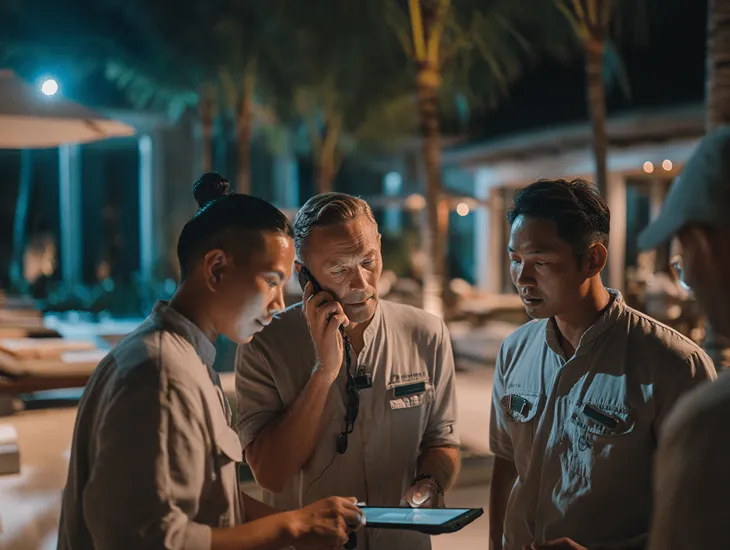
Your on-site staff are the first responders. However, without training, they may freeze or panic. You must implement clear Standard Operating Procedures (SOPs) that define exactly when to call an ambulance versus when to advise a guest to take a taxi.
For example, a minor cut might warrant a taxi to a clinic, whereas chest pain requires an immediate ambulance call. Staff must be trained to recognize these distinctions to avoid unnecessary delays or costs.
Training should also cover communication scripts. Staff need to know how to speak clearly to emergency dispatchers, providing the villa’s exact coordinates and the nature of the incident.
They must also know who to notify internally—the villa owner, the management company, and potentially the guest’s embassy if the situation is critical. Regular drills ensure that when a real emergency occurs, the response is muscle memory rather than chaos.
Real Story: A Midnight Scooter Crisis in Pecatu
Meet Bernard, a 48-year-old investor from Perth who owns a secluded three-bedroom villa in the rugged hills of Pecatu. Bernard prided himself on the extreme privacy of his property, marketing it as an “escape from the world.”
He provided guests with a local SIM card and a list of generic numbers he found online. One humid Tuesday at 2:00 AM, his guests, a young couple from the UK, crashed their scooter on a dark, gravel road just a mile from the villa entrance.
The guest, Anna, managed to call Bernard’s villa phone, but the night security guard spoke little English and didn’t understand the severity of her “head injury.” Panicked and bleeding, Anna tried calling 112 but struggled to explain their location on the unmarked road. By the time a local driver finally found them an hour later, the situation had escalated. The delay in getting her partner to the nearest hospital in Jimbaran resulted in severe complications that eventually required a costly medical evacuation to Darwin.
The fallout was immense. Bernard faced a serious negligence claim for failing to provide adequate emergency support, and his villa suffered a wave of devastating one-star reviews, destroying his occupancy for the season. Shaken, Bernard realized that “privacy” didn’t mean “abandonment.”
He immediately contracted a professional management firm to install a 24/7 emergency hotline and GPS-pinned extraction protocols. Now, when guests stay at his Pecatu hideaway, they are never truly alone, protected by a professional safety net that operates while Bernard sleeps in Perth.
Legal Obligations and Immigration Reporting
In 2026, handling an emergency also involves navigating Indonesian bureaucracy. Under Article 72 of Law No. 6/2011, accommodation providers are obligated to report foreign guests. In the event of a death, serious injury, or crime, the link between your guest reporting (APOA) and the incident becomes critical.
If the police or coroner investigates and finds the guest was not properly registered, the villa owner faces administrative sanctions and potential criminal charges.
Your Bali villa emergency assistance protocol must include a step for securing the guest’s passport and visa details immediately upon arrival, so this data is ready for authorities if an incident occurs. Cooperation with the police and immigration during an investigation is mandatory.
Professional management ensures that while the medical team cares for the guest, the legal team handles the reporting, protecting the villa owner from being implicated in a compliance violation.
Navigating Insurance and Financial Logistics
A common point of friction during emergencies is payment. Balinese hospitals and private ambulances typically require a deposit or a guarantee of payment before admission or dispatch. Villa owners should clarify in their Terms & Conditions that guests are responsible for all medical costs. However, in a life-or-death situation, the villa manager often has to bridge the gap until insurance kicks in.
It is vital to educate guests at check-in about the importance of travel insurance. Your emergency guide should advise guests to have their insurance policy number and emergency contact line ready.
While you cannot offer legal or financial advice, facilitating the connection between the hospital’s billing department and the guest’s insurer is a key part of the support role. This prevents the villa from getting stuck with an unpaid medical bill while ensuring the guest receives prompt treatment.
FAQ's about Emergency Assistance
No, there is no regulation requiring private villas to have an on-site doctor. The obligation is to ensure access to emergency services and safe facilities.
While 112/118 is a public service, "tipping" or service fees for supplies are common. Private ambulances from hospitals like BIMC charge fixed rates which are significantly higher.
For minor issues, yes. However, for serious injuries or spinal trauma, you should never move the guest. Wait for professional paramedics to avoid causing further harm and liability.
Private ambulances may refuse service without payment or insurance guarantee. This is why checking guest insurance status at check-in is a prudent operational step.
If the injury is due to villa negligence (e.g., a broken railing), the owner is liable. If it is an accident unrelated to the facility, the owner provides assistance but is generally not liable for costs.
112 is the national number, but coverage can be spotty in remote areas. It is always safer to have the direct local numbers for the nearest hospital and police station.