


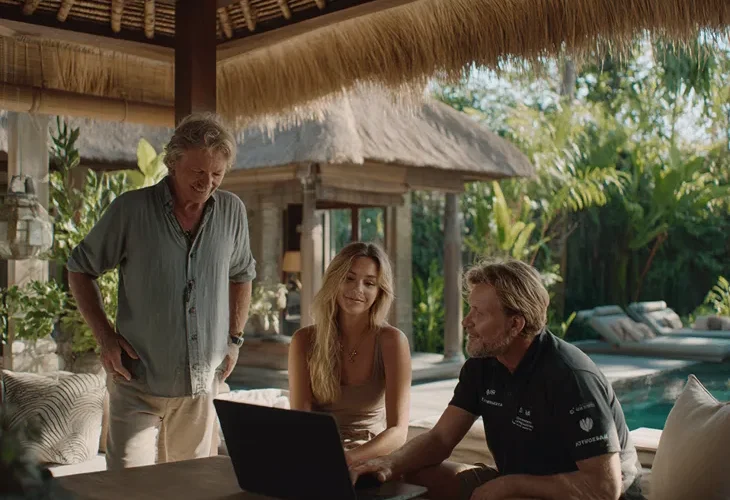
Bali villa owners often face low occupancy during shoulder seasons, relying on high-turnover tourists who are fickle and expensive to acquire through standard OTA channels. Relying on short-term holidaymakers leaves your revenue vulnerable to global travel trends and seasonal dips. The constant turnover also increases maintenance fatigue and creates unpredictable cash flow for investors.
Managing short stays means constant cleaning costs and higher wear and tear on your property, while missing out on the stable revenue of the remote workforce. This demographic seeks stability and quality, often feeling alienated by “tourist-trap” listings that lack the infrastructure needed for a professional life. For the “Elite Nomad,” a flickering internet connection or an uncomfortable chair is not just an inconvenience—it is a threat to their livelihood.
By implementing specific Packages and Strategies to Attract Digital Nomads, you can secure 30-to-90-day bookings that stabilize cash flow and reduce operational stress. This guide details how to align your property with the 2026 legal and technical standards required to capture the high-value remote worker market. Following the Directorate General of Immigration‘s updated 2026 protocols ensures your guests are legally protected while living and working in your property.
Table of Contents
The Remote Worker KITAS (E33G) in Bali and Income Triggers
To successfully attract the “Elite Nomad” segment, you must understand the residency status of your target audience. In 2026, the Remote Worker Visa (Index E33G) is the primary pathway for professionals employed by foreign companies. A critical detail for owners to note is that this visa requires proof of an annual income of at least USD 60,000. This fiscal barrier ensures that E33G holders have the significant budget necessary to afford premium private villas rather than budget guesthouses.
By marketing your villa specifically to E33G holders, you are targeting guests who are legally authorized to work remotely from Indonesia for up to two years. This residency stability makes them ideal candidates for 6-to-12-month “Digital Nomad” packages. Understanding these requirements allows you to vet guests more effectively, ensuring they possess the financial stability to maintain long-term commitments without the risk of deportation associated with overstaying tourist visas.
Multi-Entry D12 Visas for Startup Founders

Aside from corporate employees, Bali remains a magnet for entrepreneurs using the D12 Multiple-Entry “Pre-Investment” Visa. This index allows founders to stay for up to 180 days per entry over a 1 or 2-year period while conducting market research or preparing to establish a PT PMA. These “slow nomads” are less interested in beach clubs and more focused on networking, quiet environments, and professional infrastructure.
Offering founder-specific Packages and Strategies to Attract Digital Nomads—such as high-speed printers, quiet meeting corners, and proximity to coworking hubs like Tropical Nomad or Dojo—can make your villa the default choice for this entrepreneurial class. Because D12 holders frequently travel in and out of the country, they often look for “Home Base” villas where they can safely leave belongings and return to a consistent, work-ready environment.
Connectivity Infrastructure: Redundant Fiber and Starlink
In 2026, a single fiber optic line is no longer enough to satisfy a professional remote worker. Road construction in areas like Canggu and Pererenan often leads to accidental cable cuts, resulting in hours of downtime. To offer a “Zero-Downtime Guarantee,” your villa must implement redundancy. We recommend a primary fiber connection (100–150 Mbps) paired with a Starlink Roam or Residential backup system.
Starlink has become the ultimate “nomad flex” in Bali, providing reliable satellite internet that bypasses local infrastructure failures. Pairing this with a robust Mesh Wi-Fi system ensures that a guest can lead a Zoom presentation from the poolside gazebo just as reliably as from the bedroom desk. Providing a screenshot of a recent speed test in your listing photos is a high-conversion strategy that instantly builds trust with the remote workforce.
Ergonomic Workspace Design for High-Value Tenants
A “Dedicated Workspace” badge on Airbnb is frequently abused in Bali, often referring to a simple wooden dining chair and a vanity table. For long-term stays, this is a recipe for physical discomfort and guest complaints. A nomad-ready villa should feature a dedicated desk with a minimum width of 120cm, an ergonomic office chair with lumbar support, and multiple accessible power outlets with international adapters.
Lighting is equally vital; ensure the workspace has a mix of natural light (with adjustable blinds to prevent glare on screens) and warm, focused task lighting for late-night sessions. By investing in these physical assets, you move your property from a “vacation rental” to a “remote office sanctuary,” allowing you to charge a premium for monthly stays that rivals your short-term gross revenue while significantly lowering your overhead.
Monthly Pricing Benchmarks and Long-Stay ROI

Designing monthly packages requires a shift in pricing logic. While your nightly rate might be USD 150, a digital nomad is looking for a monthly “all-in” price between USD 1,500 and USD 3,500 depending on the luxury tier. In 2026, the industry benchmark is a 20% to 40% discount for stays exceeding 28 nights. While the gross daily rate is lower, your Net ROI often increases because you eliminate daily laundry costs, reduce staff call-outs, and virtually remove OTA commission fees for repeat months.
A typical nomad package should bundle electricity (with a “fair usage” cap), water, high-speed internet, and twice-weekly housekeeping. This “fixed-cost” model is highly attractive to nomads who need to manage their own monthly budgets. For the owner, this creates a predictable revenue stream that covers the mortgage and staff salaries even during the wet season, providing a financial safety net that short-term tourism cannot guarantee.
OTA Optimization and Niche Distribution Channels
To attract the right audience, you must optimize your listings for long-stay filters. Airbnb’s “Monthly Stays” algorithm prioritizes properties that offer substantial discounts and specific amenities like “Washer” and “Dedicated Workspace.” Beyond the giants, you should list on niche platforms like Nomad Stays or monthly-rental specialists. These sites attract a more professional demographic that is less likely to treat your villa as a party house.
Social media marketing remains critical. Use Instagram Reels to showcase a “Day in the Life” of a remote worker in your villa, highlighting the Wi-Fi speed and the quiet morning atmosphere. Engaging in Facebook groups like “Digital Nomads in Bali” with specific monthly offers can generate direct bookings that bypass OTAs entirely. If you lack the time to manage these channels, partnering with an established villa management firm can ensure your property is visible on the specialized platforms nomads actually use.
Legal Contracts: KBLI 55120 vs. Long-Term Leases
There is a significant legal distinction between short-term rentals and long-term leases (Sewa Menyewa) in Indonesia. Short-term rentals (daily/weekly) fall under the KBLI 55120 (Villa) category and are subject to the 10% PBJT (Hotel Tax). However, for stays exceeding one month, many owners shift to a formal lease agreement. This can have different tax implications, as lease income is often treated as PPh Final (Income Tax) rather than hospitality tax.
It is vital to have a professional contract that specifies utility caps, security deposits (typically two weeks’ rent), and maintenance responsibilities. A clear contract protects you from the risk of a “professional tenant” refusing to leave and ensures that the guest understands they are in a residential agreement, not a hotel. For high-value Packages and Strategies to Attract Digital Nomads, having a bilingual contract vetted by a local notary is a standard requirement for 2026 compliance.
Real Story: From Short-Stay Burnout to Nomad Haven
Julian, an architect from Berlin, was living his “dream” in a beautiful thatched-roof villa. But the dream became a nightmare when his Wi-Fi dropped mid-presentation for a $10k project. He spent twenty minutes sweating in the humidity, frantically trying to tether his phone while his boss’s face remained frozen on the screen. He realized then: a “pretty” villa is useless if it’s a professional dead zone.
Most Bali villas are designed for “unplugging,” but Julian needed to plug in. He needed a place that understood the difference between a tourist’s “checking email” and a professional’s “heavy rendering.” He was ready to leave Bali entirely until he found a property in Pererenan that advertised “Dual-Provider Redundancy with Starlink Backup.”
The owner hadn’t just put a desk in the corner; they had built a climate-controlled “Zoom Studio” with a mesh network that reached the pool. They even offered an E33G Visa support package in the contract.
Julian didn’t just stay for a month; he signed a 12-month lease. For the owner, the “Nomad Strategy” meant zero commission fees for the rest of the year and a guest who treated the villa like a home, not a hotel. “The redundant internet paid for itself in the first month,” the owner says. “In 2026, the best amenity isn’t a floating breakfast; it’s a stable connection.”
FAQs about Nomad Villa Packages
No. The E33G is strictly for remote work for companies or clients located outside of Indonesia. Working for local clients requires a different work permit (RPTKA).
Include a screenshot of a Speedtest.net result in your listing photos, specifically showing both "Download" and "Upload" speeds. Nomads often need high upload speeds for video calls.
This is a popular "Work-from-Bali" bundle. Offering a 20-hour monthly pass to a nearby coworking space like Tropical Nomad can be a major selling point for those seeking a community.
We recommend a "Fair Usage" cap (e.g., IDR 1,500,000/month). Any amount exceeding this is charged back to the guest, incentivizing them to turn off air conditioning when not in the room.
If they stay in Indonesia for 183 days or more in a 12-month period, they are generally considered tax residents. However, certain "territorial" exemptions may apply for foreign-sourced income.
Yes, and it is highly recommended. A standard 2026 practice is a deposit equivalent to 25% of the total stay value or a fixed two-week rate to cover potential damages.