


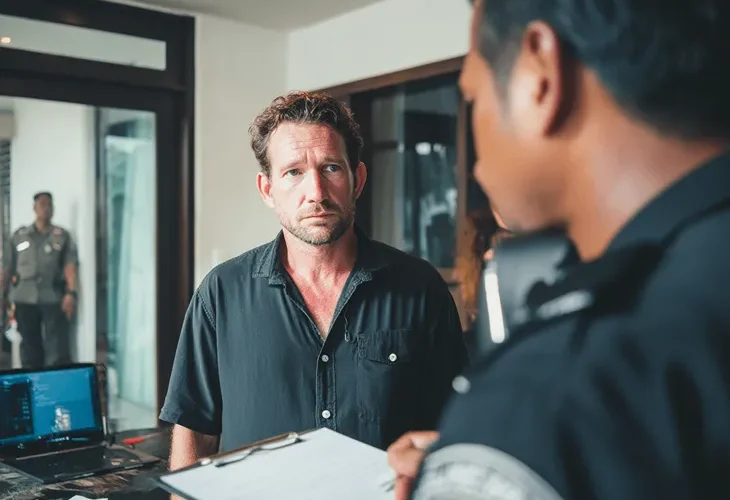
In the evolving regulatory landscape of 2026, the days of informal hospitality in Bali are effectively over. For villa owners and foreign investors, the requirement to report every foreign guest to the authorities has shifted from a passive administrative task to a high-stakes legal obligation.
Failing to submit a timely report is no longer a minor oversight; under the amended Immigration Law, it is a criminal offense that can lead to imprisonment, heavy fines, and the immediate sealing of your property.
The agitation among the expat community is palpable as the Directorate General of Immigration intensifies its “Jagratara” surveillance operations across Bali. Officers now utilize real-time digital tracking to cross-reference actual villa occupancy with the data submitted to the central server.
If you are running a villa and relying on a freelance maid to “handle the police paper,” you are exposing yourself to massive liability. The disconnect between casual island vibes and strict national security protocols is where many businesses fail.
The solution is a disciplined, non-negotiable standard operating procedure for Guest Registration. By integrating the APOA-NG (Aplikasi Pengawasan Orang Asing – New Generation) system into your daily workflow, you create a digital shield around your investment. This guide details the exact mechanisms of the current reporting regime, ensuring your villa remains a sanctuary for guests rather than a target for immigration task forces.
Table of Contents
Legal Basis: Law No. 63 of 2024 and Article 72
The foundation of mandatory reporting lies in Indonesia’s Immigration Law No. 6 of 2011, significantly strengthened by the amendments in Law No. 63 of 2024. Specifically, Article 72 paragraphs (1) and (2) explicitly oblige “owners or managers of accommodation” to provide detailed information on foreign nationals staying at their premises. This is not a suggestion; it is a statutory command that applies the moment a foreigner places their bags in your room.
In 2026, the definition of “accommodation” was legally broadened to close any loopholes previously exploited by private rentals. Whether you operate a five-star resort in Nusa Dua or a single-bedroom Airbnb in Pererenan, you are viewed as an accommodation provider under the law. The legal onus falls directly on the owner or the registered management company to ensure transparency with the state regarding who is residing on Indonesian soil.
Scope of Obligation: Who Must Report?

Many foreign investors mistakenly believe that Guest Registration requirements apply only to classified hotels. This is a dangerous myth. The obligation applies nationwide to every form of lodging, including private villas, guesthouses, co-living spaces, and boarding houses (kos-kosan). If a foreign national sleeps at your property, their presence must be logged.
For villa owners using a nominee structure or a leasehold arrangement, the liability often flows to the person “beneficially” running the business. If you are the one collecting revenue and managing the calendar, Immigration considers you the responsible party. Ignoring this duty because “it’s just a private villa” invites scrutiny not only from immigration officers but also from tax authorities who use occupancy data to verify revenue declarations.
The APOA-NG Ecosystem: Digital Surveillance
The Directorate General of Immigration has operationalized this mandate through the APOA-NG platform. This “New Generation” system is a centralized digital database that feeds real-time information to intelligence divisions across the country. Gone are the days of dropping physical carbon copies at the local police station once a month; the APOA-NG system demands near-instantaneous data entry and includes features for guest self-reporting via QR codes in some specific zones.
Once a villa is registered in the system, the operator receives a unique QR code and login credentials linked to their business license. The system is designed to flag discrepancies immediately—such as a guest checking into your villa while their visa status shows “overstay” or “deported.” For the compliant owner, APOA-NG is a tool of protection, proving that you have done your due diligence on every person entering your property.
Step-by-Step Workflow for Mandatory Reporting in Bali
Compliance requires a rigid workflow that your front office or villa manager must follow without exception. The process begins at check-in. Staff must physically inspect the guest’s passport and valid visa. Relying on guests to “send a photo later” is a critical failure point. The data—including full name, passport number, and visa type—must be uploaded to the APOA-NG portal immediately.
While the law technically allows for a 24-hour reporting window, in the age of digital surveillance, any delay is viewed with suspicion during a surprise audit. The best practice is “Real-Time Submission.” Additionally, the check-out report is equally vital. When a guest leaves, the system must be updated to close their stay record. Leaving a guest “active” in your system after they have departed can cause alarms if that guest is later found involved in legal issues elsewhere.
Real Story: The Cost of a Missing Passport Scan
Amelia, a digital nomad from Canada, ran a beautiful Joglo in Pererenan. She loved the “community feel” of her retreat and hated “bureaucracy.” When a friend of a friend stayed for ten days, Amelia skipped the passport scan. She didn’t want to “ruin the vibe” with paperwork.
One Tuesday morning, two men in plain polo shirts arrived at her gate. They weren’t tourists; they were Immigration Intelligence. Without raising their voices, they opened a tablet and showed Amelia her own “Sold Out” calendar from a booking site. “You have three guests checked in,” one officer said. “We only see two in the APOA-NG system. Who is in the third room?”
Amelia realized her “vibe” had just cost her a fortune. The guest she hadn’t reported was on a visa overstay from a previous trip. Because Amelia hadn’t logged the passport, she was legally liable for “harboring” a fugitive.
Amelia was fined IDR 25,000,000 on the spot. But the real pain was the “Yellow Ribbon.” The officers placed a formal surveillance notice on her gate, scaring away her next three bookings. “The fine was high, but the loss of trust was higher,” Amelia says. “Now, the passport scan happens before the guest even gets their room key. No scan, no stay. Period.”
Penalties, Enforcement, and Business Risks

The penalties for non-compliance are severe and strictly enforced. Under Article 117 of Law No. 6 of 2011, accommodation owners who fail to provide the requested information face up to three months of imprisonment or a fine of up to IDR 25,000,000. In the current climate, authorities are prioritizing fines and administrative sanctions to clamp down on illegal tourism.
Beyond the statutory fines, the operational risk is the “sealing” of the property. Satpol PP (Civil Service Police) works in tandem with Immigration. If a villa is found to be repeatedly non-compliant, it can be physically sealed with yellow tape, forcing the eviction of all current guests and the cancellation of future bookings. This reputational damage is often fatal for a hospitality brand in Bali’s competitive market.
Integration with National Police (STM, SKSKP & APOA)
Historically, guest reporting involved a separate report to the police called the STM (Surat Tanda Melapor). In 2026, while the police still utilize the STM for security monitoring, the APOA-NG system serves as the primary data aggregator shared with intelligence agencies. However, the obligations deepen for long-term guests.
If a foreign guest (especially one holding a KITAS) stays for more than 30 days, simply scanning a passport is insufficient. They may be required to obtain an SKTT (Surat Keterangan Tempat Tinggal) or SKSKP (Surat Keterangan Susunan Keluarga Pendatang) from the local Civil Registry (Dukcapil) and village head. A professional management team ensures that these layers of reporting—from the immediate immigration ping to the long-term village registration—are handled seamlessly to prevent local friction.
Common Operational Mistakes to Avoid
The most frequent error is the “delayed batch reporting.” Managers often wait until the end of the week to upload guest data to save time. This is dangerous. If a crime occurs or an inspection happens on Tuesday, and your Sunday arrivals are not yet in the system, you are non-compliant. Real-time reporting is the only acceptable standard.
Another critical mistake is failing to verify the data input. A typo in a passport number or an incorrect date of birth renders the report invalid. Furthermore, many owners fail to register sub-hosts or night security staff as authorized users on the APOA-NG account. If the primary manager is sick and a guest arrives, no one else knows how to access the system, leading to a gap in coverage. Redundancy in access and training is essential.
FAQs about Guest Reporting
The strict requirement under Article 72 focuses on foreign nationals (Orang Asing). However, general police regulations often require logging all guests for security purposes. Best practice is to maintain a full guest register for everyone.
No, the APOA platform is a government compliance tool and is free to use. You should never pay an agent specifically just "to access" the portal, though management fees may cover the labor of doing the reporting.
Technical glitches happen. You must manually document the guest's details and passport scan immediately (timestamped) and upload the data as soon as the system is back online to prove you attempted compliance.
Technically yes, but legally the liability remains with the owner. It is high-risk to entrust this to staff without rigorous training. One missed entry can cost you millions in fines.
No. OTAs like Airbnb and Booking.com do not link directly to the Indonesian Immigration database. The Guest Registration must be performed manually by the host or manager outside of the booking platform.
While the law implies a 24-hour window, 2026 enforcement expects real-time submission. Reporting within hours of arrival eliminates suspicion during surprise inspections.