


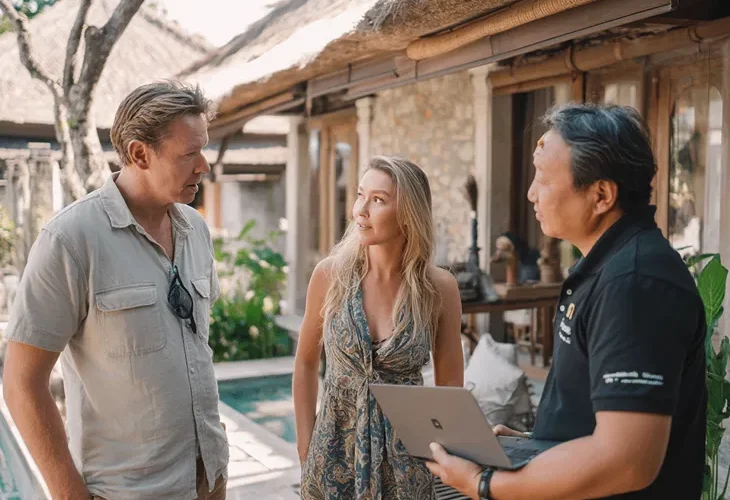
Navigating the 2026 licensing landscape for a villa in Bali can feel like a labyrinth. Many foreigners risk operational shutdowns due to outdated permits or incorrect zoning. The fear of an unexpected inspection or a sudden “sealing” of the property is a constant shadow for many villa owners.
Without a valid permit, your property is a direct target for regional task forces. The shift from the old IMB to the modern PBG/SLF system has left many investors confused about their current legal standing and revenue safety. Operating in the shadows is no longer a viable strategy for high-end assets.
Professional support simplifies this process significantly. By securing the correct registration now, you protect your investment and ensure long-term occupancy growth within official Ministry of Tourism regulations. This guide outlines the essential steps to achieve full compliance and peace of mind for your hospitality business.
Table of Contents
Understanding the 2026 Compliance Layers in Bali
To operate a short-term rental legally in Indonesia, your property must satisfy three distinct layers of government oversight. The first layer is land and building legality, which involves verifying that your physical structure is approved for the specific purpose of housing tourists. The second layer is your business registration, which links your identity or company to the property through the Online Single Submission (OSS) system. The final layer involves ongoing maintenance and renewal of these documents to reflect current regional policies.
Securing a Bali Villa License in 2026 requires more than just a one-time application; it demands a continuous commitment to local standards. Support services now focus heavily on ensuring that all three layers—Zoning, Building Fitness, and Tourism Certification—are synchronized. This holistic approach prevents common administrative bottlenecks where a valid business license is undermined by an invalid building certificate, a frequent issue in regencies like Badung and Gianyar.
Categorizing Your Property: Corporate Villa vs. Pondok Wisata

Choosing the correct category for your property is vital for legal survival. In 2026, the Pondok Wisata (KBLI 55120) remained a “Low Risk” or “Medium-Low Risk” category reserved for local SMEs and small accommodations, typically capped at five bedrooms. For a PT PMA (Foreign Investment Company), the government mandates the Villa (KBLI 55120) classification under a Medium-High risk tier. This requires a “Standard Certificate” that must be verified by the Tourism Office.
Unlike small local homestays, a PT PMA cannot simply “use” a Pondok Wisata permit. You must register as a Corporate Villa Operation, which involves meeting a specific capital realization requirement of IDR 10 Billion (excluding land and buildings). This corporate path ensures that your Bali Villa License is backed by the appropriate investment commitment, allowing you to operate a high-end commercial complex legally rather than attempting to hide under a residential-style permit.
Zoning and Spatial Use: The First Hurdle
Zoning is the absolute foundation of your Bali Villa License. In 2026, the government utilizes the KKPR (Kesesuaian Kegiatan Pemanfaatan Ruang) to verify that your land is designated for tourism use. Bali is strictly divided into “Pink Zones” for commercial tourism and “Green Zones” for agriculture or protected landscapes. If your villa sits on agricultural land, it is legally impossible to obtain a tourism license, regardless of the quality of the building.
Support providers conduct thorough spatial audits before any application is submitted. This step confirms that the land’s RTRW (Regional Spatial Plan) matches the intended commercial activity. Many investors have been caught out by “zoning shifts” where land previously considered residential was re-zoned. Verifying your spatial permit through the local DPMPTSP office is the only way to ensure your property remains eligible for long-term rental operations.
Building Permits: Transitioning from IMB to PBG
A major point of confusion for villa owners is the transition from the old IMB (Izin Mendirikan Bangunan) to the new PBG (Persetujuan Bangunan Gedung). The PBG is not just a name change; it represents a more rigorous set of technical standards for construction and safety. For those looking to renew an existing permit or legalize a new build, the PBG is a mandatory requirement that must be secured before any tourism business license can be issued or updated via the OSS.
For owners of older villas, this transition often requires a technical audit to ensure the structure meets 2026 safety codes. The PBG serves as the permanent permit for the building, but it is only valid if the building’s use remains consistent with the original application. If you have added rooms, a pool, or a second story to your villa without updating your building permit, your entire business registration could be considered fraudulent during a local government audit.
The Critical Role of Sertifikat Laik Fungsi (SLF)
The SLF (Sertifikat Laik Fungsi) has become the most scrutinized document in the Bali property market. It is a certificate that confirms your building is structurally sound, functionally safe, and fit for human habitation. In 2026, you cannot legally obtain or renew your Bali Villa License without a valid SLF. While an SLF for purely residential use may be valid for longer, ensure your SLF is renewed every five years for commercial use to keep your business license active.
Obtaining an SLF involves inspections of the electrical systems, fire safety equipment, and wastewater management (SPPL). For many older properties, this is the most difficult hurdle to clear, as it may require retrofitting systems to meet modern standards. Professional support during this phase includes coordinating with certified technical inspectors who can identify gaps and provide recommendations for necessary upgrades before the official government review takes place.
Real Story: Julian’s Structural Shift in Berawa
Julian, a developer from Sydney, stood on his Uluwatu balcony as the sun dipped into the Indian Ocean. But he wasn’t looking at the view. He was looking at a “Warning Letter” from the local Satpol PP. His old IMB permit—the one he thought was his “shield”—had been flagged as “non-compliant” in the new 2026 digital sweep.
Julian’s villa was a masterpiece, but legally, it was a “ghost.” He lacked an SLF (Sertifikat Laik Fungsi), and his electrical system didn’t meet the 2026 fire safety codes. The digital OSS portal had frozen his business ID, meaning he couldn’t legally process credit card payments from his guests. He was forty-eight hours away from being “sealed” and evicted.
Julian stopped trying to “wait it out.” He engaged a professional licensing team to perform a full technical audit. They didn’t just file papers; they retrofitted his wastewater system and brought in a certified architect to issue a structural safety report.
Within weeks, Julian’s OSS status turned green. He received his PBG and a fresh 5-year SLF. “The cost of the permit was nothing compared to the cost of losing my booking revenue for a month,” Julian says. “I used to jump every time a government car drove past. Now, I welcome the inspectors with a coffee and my verified QR code. I’m finally the boss of my own dirt.”
The OSS-RBA Registration Process Explained

The Online Single Submission Risk-Based Approach (OSS-RBA) is the digital gateway for all business permits in Indonesia. Once your building permits (PBG/SLF) are in order, the next step is obtaining your NIB (Business Identification Number) and the specific tourism standard certificate. The system categorizes businesses by risk; most private villas are considered “Medium-High Risk,” meaning they require a self-declaration of standards followed by a verification process from a certified body.
Navigating the OSS portal requires precision. Incorrectly mapping your KBLI (Standard Classification of Indonesian Business Fields) code can lead to your application being rejected or, worse, being flagged for an investigation. Professional Bali Villa License support ensures that your company data, land rights, and environmental commitments are perfectly aligned within the digital system, triggering the electronic issuance of your operational permit without the traditional delays of physical paperwork.
Risks of Non-Compliance and Operational Sealing
The consequences of operating without a complete permit stack have never been higher. In 2026, joint task forces involving the Civil Service Police (Satpol PP) and the Tourism Office conduct regular sweeps of popular areas like Uluwatu and Pererenan. Properties found without a valid Bali Villa License risk being “sealed”—essentially padlocked by the authorities—with guests evicted immediately. This results in massive financial losses, reputational destruction on platforms like Airbnb, and potential blacklisting for the owner.
Beyond administrative sealing, there are significant tax and immigration risks. An unlicensed villa is technically an illegal business, which can trigger an audit of the owner’s NPWP (Tax ID) and potentially lead to charges of working illegally if a foreigner is found managing the property personally. Total compliance is the only insurance policy that protects both your property rights and your residency status in Indonesia.
FAQs about Bali Villa Licensing
Typically, a Pondok Wisata license must be renewed or re-registered every 3 years. However, you must also obtain a tourism standard certificate within 2 years of your initial business registration.
You can apply for the building permit (PBG) during construction, but the operational tourism license requires the building to be finished and issued an SLF certificate.
Yes. Adding F&B or wellness services may require additional KBLI codes and health/hygiene certifications to remain fully compliant with 2026 standards.
Yes. As of the current 2026 regulations, an SLF is a mandatory prerequisite for all commercial and residential buildings to ensure safety and structural integrity.
The government does not charge a fee for the electronic issuance of the NIB or standard certificates. Costs are typically incurred for technical studies, notary fees, and consultancy.
Generally, no. This license is for Indonesian citizens. Foreigners typically manage the property through a PT PMA or a management agreement with a licensed entity.