


As Bali’s property market matures, the era of sprawling, isolated villas is giving way to a smarter, more efficient trend: the townhouse cluster.
For foreign investors and long-stay residents, the scarcity of prime land in hotspots like Pererenan and Berawa has driven prices to record highs, making traditional villa ownership increasingly prohibitive.
The frustration is palpable; buyers are desperate for a foothold in the market but are priced out of freehold-equivalent options or terrified by the horror stories of solitary villas in green zones facing demolition.
The shift towards townhouse living addresses these pain points directly, offering a “lock-and-leave” lifestyle that blends privacy with community security.
However, navigating this new asset class is not without its perils, particularly regarding the nebulous “strata title” regulations for foreigners and strict zoning enforcement.
Without the correct legal structure, what looks like a modern investment can quickly become a compliance nightmare.
This guide unpacks the operational and legal realities of this emerging sector. We explore how to secure a townhouse accommodation in Bali asset that is not only architecturally stunning but also legally robust under the latest Indonesian investment laws. By understanding the nuances of PT PMA ownership and community zoning, investors can capitalize on high yields while mitigating the risks that plague the uninitiated.
For official guidance on business licensing for such developments, the Online Single Submission (OSS) system remains the primary authority.
Table of Contents
Defining the Townhouse in Bali : More Than Just a Villa
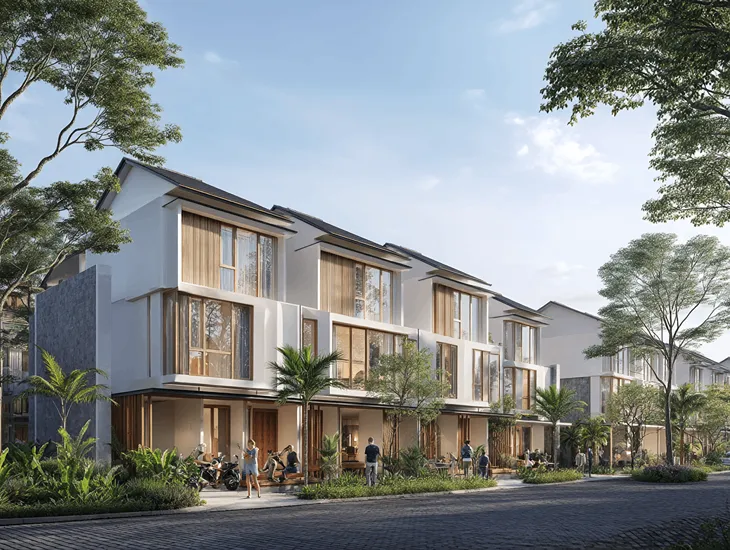
In the current market, “townhouse villas” represent a hybrid between a low-rise condominium and a private landed house.
Typically designed as two-story units within a secured cluster, they offer private entrances and often small plunge pools, but share critical infrastructure like access roads, security posts, and parking areas.
This design evolution aligns perfectly with the 2026 demand for “Modern Minimalist” or “Japandi” aesthetics—styles that prioritize enclosed, air-conditioned comfort and functional, tech-enabled spaces over sprawling tropical gardens that require constant maintenance.
From a planning perspective, these developments function differently than standalone properties. Because they share walls and amenities, they often fall under specific permitting categories that resemble housing estates.
For investors, this distinction is vital. A townhouse accommodation in Bali project must be meticulously planned to ensure it meets the density and environmental standards of its specific regency, offering a streamlined lifestyle that appeals heavily to the growing demographic of digital nomads and young families seeking safety and convenience.
Legal Ownership Structures for Foreign Buyers
The legal landscape for foreigners in Indonesia remains strict: direct freehold ownership (Hak Milik) is prohibited. However, the townhouse model opens up specific pathways that are both secure and compliant.
The most common structure involves a PT PMA (Foreign Investment Company), which allows the entity to hold Hak Guna Bangunan (HGB) or “Right to Build” titles. This is the gold standard for anyone intending to operate their unit as a commercial rental business.
Alternatively, for those seeking a purely residential foothold, the Hak Pakai (Right to Use) title is available for qualifying individuals.
While regulations regarding “strata titles” for foreigners exist on paper, implementation can be inconsistent. Legal experts in 2026 suggest that many “strata” schemes still rely on convertible leaseholds rather than true ownership certificates.
Therefore, due diligence is non-negotiable; verifying that the underlying land title supports the specific unit structure is essential before committing capital to any townhouse accommodation in Bali development.
Zoning Essentials: Where You Can Actually Build
Zoning is the silent killer of property dreams in Bali. The government’s enforcement of spatial planning (Tata Ruang) has intensified, meaning that building a townhouse complex in a “Green Zone” (agricultural land) is a guaranteed route to sealing or demolition.
Townhouse projects must be situated on land zoned specifically for Housing (Pemukiman), Tourism (Pariwisata), or specific Mixed-Use zones (Campuran).
This zoning designation dictates not just the legality of the physical structure, but also the business licenses you can obtain later.
A project built on residential-only land generally cannot legally acquire the tourism licenses (Pondok Wisata) required for daily rentals. Investors looking for a high-yield townhouse accommodation in Bali asset must confirm the “Pink” (Tourism) or “Orange” (Mixed) zoning status via a formal KKPR certificate before signing any agreements, ensuring the property can legally generate the short-term rental income often promised in marketing brochures.
Why Operational Costs favor the Townhouse Model
One of the primary drivers behind the townhouse boom is operational efficiency. Maintaining a standalone villa in Bali’s humid climate is expensive—pool pumps break, roofs leak, and security staff salaries add up. In a townhouse cluster, these costs are shared.
The “sinking fund” model, common in Western strata developments, is increasingly being adopted here, allowing owners to split the bill for 24/7 security, landscaping, and waste management.
This shared infrastructure significantly lowers the per-unit operating cost, boosting net rental yields. For a savvy investor, a townhouse accommodation in Bali unit offers a more resilient income stream compared to a standalone villa, where a single major repair can wipe out months of profit.
Furthermore, centralized management ensures consistent service standards, which is critical for maintaining high ratings on platforms like Airbnb and Booking.com, where guest expectations for cleanliness and security are higher than ever.
Real Story: The Community Advantage in Canggu

Olivia (34, Toronto) quickly discovered the dark side of privacy. Her secluded villa in Canggu looked perfect online, but the reality was unnerving.
To get home, she had to navigate a pitch-black, unpaved gang (alleyway) on her scooter, leaving her feeling vulnerable every night.
On top of that, deafening construction noise next door shattered her peace during the day.
Realizing that “secluded” actually meant “isolated and noisy,” Olivia sought a safer solution. She reached out to Bali Villa Management, and we introduced her to a secured townhouse cluster in Batu Bolong.
She traded lonely autonomy for 24-hour security, fiber-optic internet, and a shared co-working space.
“I didn’t realize how much I missed having neighbors until I moved here,” Olivia told us. “I have my own private plunge pool for downtime, but I feel part of a community.”
The shift transformed her experience; she extended her stay for a year. For the owner of that unit, Sarah’s long-term tenancy meant zero vacancy and a steady premium income, proving that the right townhouse accommodation in Bali solves real problems for modern expats.
Step-by-Step Guide to a Compliant Project in Bali
- Site Verification: Begin with a rigorous check of the land’s zoning (RDTR) and title history. Ensure the plot allows for the density of a townhouse cluster.
- Structuring: Establish your PT PMA if the goal is commercial operation. This entity will hold the HGB title or the master lease.
- Permitting (PBG): Apply for the Persetujuan Bangunan Gedung (PBG). The application must explicitly state the function—whether it is a residential complex or tourism accommodation. Misclassifying this to save money is a major risk.
- Construction & SLF: Once built, obtain the Sertifikat Laik Fungsi (SLF) to certify the building is safe and habitable.
Licensing (OSS): Finally, register for the appropriate KBLI (business classification) via the OSS system to legally market your townhouse accommodation in Bali to tourists.
Understanding Fees, Timelines, and Infrastructure
Developing or buying into a townhouse project involves a complex fee structure. Beyond the purchase price, investors must budget for notary fees (typically 1%), BPHTB (land acquisition tax), and potentially VAT (PPN) which is 11% or more depending on current regulations.
Infrastructure costs for these clusters—such as upgrading transformers for stable electricity and installing advanced wastewater treatment systems—are higher upfront but amortized across multiple units.
Timelines in 2026 remain fluid. While the OSS system is digital, the physical verification for PBG and SLF can take months.
Delays due to design revisions or zoning clarifications are common. Investors should view any promise of a “guaranteed” 12-month completion for a townhouse accommodation in Bali project with healthy skepticism.
A realistic timeline accounts for bureaucratic hurdles, ensuring that when the keys are finally handed over, the asset is fully compliant and ready for business.
Critical Risks in Bali: Zoning Mismatches and Licensing
The most significant risk in this sector is the zoning mismatch. We see developers marketing townhouse clusters on “Yellow” (Residential) land as high-yield daily rental machines.
While physically possible, this is legally precarious. If the local government enforces the rules, these operations can be shut down for lacking a tourism license.
A purely residential townhouse accommodation in Bali can generally only be rented long-term (monthly or yearly), drastically affecting ROI projections based on daily rates.
Another common pitfall is ownership confusion. Avoid “bundled” deals where a nominee holds the master title and you hold a weak side agreement.
These structures offer zero legal protection. Always insist on a registered lease or HGB title in your own name or company name. Furthermore, under-specifying community rules can lead to conflicts.
Clear, binding agreements on noise, pet policies, and common area usage are essential to preserve the value and livability of the cluster.
FAQs about Townhouse Villas
You cannot own freehold (Hak Milik), but you can effectively "own" a townhouse accommodation in Bali unit through a long-term lease or an HGB title under a PT PMA company.
They often offer higher stability and lower operating costs, making them excellent for risk-averse investors, though capital appreciation on standalone land might be higher in some contexts.
Yes, provided the land is zoned for tourism and you have the correct business licenses (KBLI) and tax registration.
Most leasehold townhouses are sold with 25 to 30-year terms, often with pre-agreed extension options.
While legally possible on paper for high-rise condos, true Strata Title for low-rise townhouses is rare and complex; most "strata" deals are actually shared leasehold structures.